• 0 Knjige - 0,00 
    • Košarica je prazna.

Picture Books

Once

12,00 

In this extraordinary picture-book the story keeps returning to its beginning. At every page, Igor Rajki starts out with the classical formula “Once there was a…”, only to interrupt the narration and turn to something else. The little sketches created in this way as well as the reasons the author offers for never finishing any of his stories finally build up to a hilarious mosaic of anecdotes while constructing a somewhat nervous but highly entertaining narrative voice. The visual artist Krešimir Zimonić responded to the fragmentary narrative style by using techniques of collage which combine drawings, photographs, graffiti styled writings and “ready-made” visual material. Once is, for this reason, a thoroughly sketchy and incredibly rich little book.


Piccola con piccolo

13,00 

The little girl Piccola shows an unusual feeling for sounds. Imitating the chirping of birds, the crackling of fire, the sounds of the wind and everything else that surrounds her, Piccola amazes the listeners singing her little melodies. When she comes to a
music school and old Professore starts teaching her to play the piccolo, the smallest girl with the smallest flute becomes ‘Piccola con piccolo’; her Bird Music becomes a huge success and she is invited to perform all over the world. Piccola con piccolo
is the first picture book written by Bruno Mezić. Creating a likable character of the little girl Piccola,
telling about her adventures in sound, and skillfully playing with Italian words, the author introduces young readers to the terminology of classical music. Illustrations by the young visual artist and designer Klasja Habjan imaginatively and playfully follow the text and bring to life the original little heroine and her music.


Book #3705


Safe Journey

14,00 

Beatrice Masini and Gianni De Conno, the award-winning Italian tandem, communicate in this picture book the artistic and emotional experience of travelling. The combination of magnificent oneiric images and the poetic prose takes us on a journey into the unknown: sometimes the destination is known, and sometimes the trip is just aimless wandering; sometimes we encounter obstacles and surprises, sometimes “treasures we don’t know yet of.” Every journey is a unique experience; and the insights we gain, the feelings we go through, and the memories we create are its precious consequences. Attractive illustrations and suggestive short sentences stimulate imagination and their dreamy quality has won numerous readers; in 2018 Beatrice Masini and Gianni De Conno received the most prestigious prize in the field of children’s literature “SuperPremio Andersen”. For the great Gianni De Conno, this picture book marked the end of a life’s journey; it is the last and farewell gift he left us before his untimely death.


Book #3340

Saturn at the Winter Swimming Pool

20,00 

The story begins one January morning when the planet Saturn suddenly materializes in the big swimming pool, at first in a smaller version of itself. The unexpected event shakes up the sleepy routine of the regular visitors of the swimming pool called ‘Future’. Lacking logical explanations, but brimming with their own ideas, they try to adapt to the new circumstances, hoping the planet will go away on its own. Some try to extract profit from the event, others pretend that nothing is happening, but finally it becomes clear to them all that they simply have to kick out the constantly growing Saturn out of their pool while it’s still possible! This picture-book, fully authored by Vendi Vernić, one of the foremost Croatian illustrators of the younger generation, will appeal to readers of all ages. The story can be read and interpreted on multiple levels: as an absurdist game of imagination, as a little study of a specific community, or as an allegory on melancholy and depression.

Serna and Mack in Pursuit of the Frightened Month

15,00 

In his first prose text the young author uses patterns of traditional storytelling to speak about the contemporary problem of climate change. January disappeared, frightened by the absence of winter; a girl and a household spirit set off on a journey through the world of calendar, trying to find him and persuade him to come back. Adroitly following the spirit of the text, the illustrator uses elements from traditional book illustration, blending them with modern technique and expression.


Book #3348

Six Walks of Slava Raškaj

15,00 

This picture-book is the first within a series with which Mala zvona introduces works of great Croatian visual artists to children. The famous Croatian impressionist painter S. Raškaj was deaf – and very sensitive to nature. Therefore, the writer of this picture book chose to represent her life and work in six walks with easel in different surroundings: the garden of her childhood, parks in the city where she learned to paint, winter woods and summer meadows where she made her best pictures. The illustrator did not copy the style of watercolors made by S. Raškaj, but gave the adequate transparence and lightness to his own.


Book #3338


The Creepy House

16,00 

The Creepy House is a skilful blend of a story about a family intending to move from the city to an old house surrounded by nature, an old-fashioned game of riddles, and fairy-tale elements that lend the whole book an air of fantasy that children find so irresistible. Solving the riddles given to them by the mysterious voice from the fireplace, Florijan and Klara explore the house and the garden, noticing so many things they did not see at first. With a bit of fear and lots of laughter, they experience a real adventure in search of a key they will use to ‘unlock’ the magic of their future home… The author shows a very good understanding of a child’s way of thinking and combines an imaginative plot with a subtle educational element about the world of plants and animals. The illustrator follows the story closely, complementing it with a number of small artistic surprises.

The Fly in the Atelier of Ivan Kožarić

15,00 

How to introduce children to the world of a famous conceptual artist? The author of the text chose a character from the artist’s notebook, a little fly. Accidentally it enters the atelier – where all objects are wrapped in paper (the situation taken from real life). One by one they unwrap themselves for the little fly, telling and singing their stories. The illustrator creates the magical space of the atelier with highly original inventiveness, masterfully inserting citations of Kožarić’s works.


Book #3419

The Little Key

17,00 

Starting from a banal event – a shoe that was untied and a key found on the street – the little heroine of this picture book talks about her loved ones. For each of them, such a key could serve something, unlock something of theirs: mom’s glass showcase, dad’s mysterious drawer, a compartment with love letters in grandma’s cabinet, a friend’s special pencil case, her brother’s box with figurines of dragons and knights. With each contemplation of the key, an image from everyday life is “unlocked”. But in the end, the girl concludes that the key will best serve her and her own imagination.
The author of this story about curiosity is the acclaimed and experienced writer Sanja Lovrenčić, and the book was illustrated by Lucija Mrzljak, an award-winning artist educated in Zagreb, Prague, Krakow and Tallinn.

The Moon in December

At first glance, the Moon seems to be the central character of these “twelve stories for daydreaming”, but various other characters alternate under its shine and go through many unexpected experiences: under its light, snow owls hold their annual ball, it serves the little fairy as the highest jump in the sky, a mouse will use it as a model for a picture of the ideal cheese… When it disappears from the sky, four cats go in search of it, and when it reappears it will serve as a swing for three crazy dogs, winners in howling competition… (illustrated by Pika Vončina)

The Sneering Bird

16,00 

Illustrating a fable about a parrot run away from the ZOO who meets various animals and finds all of them for some reason ridiculous until a fox teaches it a lesson, the artist Ivana Pipal finds ingenious ways of representing basically the same situation: the parrot and another animal. Giving each protagonist mood and personality, and creating at the same time deeply pleasant green world of the woods, she turns the tale about understanding and accepting others into rich visual pleasure.


Book #3396


The Story of Golem

13,00 

Drawing on the Jewish visual and literary tradition, Melita Kraus rewrites the legend of Golem of Prague, highlighting its fantastic and amusing side: funny episodes, caused by the fact that Golem’s creators succeeded in making him alive and strong, but not very bright, make the story lively and full of surprises. Placing the frame story (about a little boy who gets lost in the old Prague) in the present time, and narrating in a simple and contemporary language, Melita Kraus establishes a close relationship with the young reader, and draws her/him into the world of her imagination.


Age: 6-8

The Voyage of Aunt Hilda

10,00 

Hilda is an adventurous chicken (rare thing in a chicken house); she embarks on a long journey, searching for the river Limpopo. Her adventures are told in words and pictures, in a series of postcards that she sends to her friends who have stayed home (as a normal chicken should). Her postcards are never just landscapes; the picture always shows someone she met on the road: two ladybugs who lost their sister, a pig prince, a walking hill, a cat teacher teaching only the letter A, and a number of other characters whose stories she tells in just a few words. They make a pleasant reading, full of little surprises that excite wonder and laughter.

Age: 4-6

Tintin and his Friends

17,00 

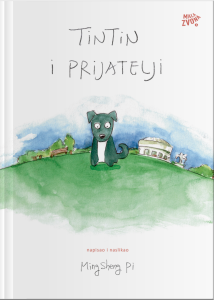
A basket for mushroom picking, a blanket, and a little black dog – that’s how this story begins. Even though he was abandoned in the forest, the little dog was lucky: he was adopted by two nice people. “Tintin and his Friends” is a diary of the first year they spent together, recorded mainly from the dog’s perspective. We see various little events, from their life at home to from their walks in the park, feeling the warmth the three of them share and following Tintin’s adventures with various dog-friends. In a multitude of small scenes Mingsheng Pi – a Chinese painter based in Zagreb and Tintin’s owner – tells, almost without words, a gentle and cheerful story about animals and people, showing an exceptional talent to spot details and, with just a few strokes of his brush, to evoke a space, an atmosphere, characters, and their relations. Readers of all ages will enjoy Tintin’s adventures, and the youngest among them will learn something new about dogs and their humans – like the importance a dog may have for a with hearing-impaired person.

We, the Mice

12,00 

“We, the Mice”, a new picture book by Pika Vončina, is a sequel to her series of picture books about a fantastic animal world. Four stories about a harmonious family of mice are told by Erik the Unstoppable, the mouse who got his nickname because he constantly asks curious questions. His family does not live in “holes” but in nice and comfy dwellings, eating a variety of fruits and vegetables (sometimes even cheese!), loving music and gardens…

The text is handwritten in large block letters, which allows younger children to read it on their own, and helps them as an additional motivation in the process of learning to read and write. The diversity of characters and settings stimulates the development of children’s imagination and deepens their perception and emotional intelligence.

Ages 4-7


Why Bach Said Ah

15,00 

Vesna Matana Matić, an experienced musician with pedagogical experience, in her playful fantasy on the subject of classical music and modern technology, conjures up the great composer surrounded by his numerous children. Children’s cries, laughter and insistent questions are the lively background against which Johann Sebastian’s works are created – until the moment when the composer calls for help from the future, so that he can work in peace. Help does indeed arrive, in the form of a little girl, Selfiene, who gives Bach’s children smartphones. A silence ensues in which no one even notices the house cat any more. But this silence is not in the least stimulating: the melodies in the composer’s head have also fallen silent… This picture book is designed so that the youngest readers can learn something about classical music in a fun way, but also to reflect on the changes that electronic devices have brought to family life. The text is accompanied by imaginative illustrations by the young artist Doria Jantolić.