• 0 Knjige - 0,00 
    • Košarica je prazna.

Knjige

Fairy Tale of Shallow Waters

10,00 

Picture book based on seashore debris used to evoke a setting and to provoke a story: shells and rubble become seashore, stones and wire become fish, and a little pebble-island becomes a witness of a fair tale that suddenly happens in the shallow water. The writer and the illustrator create an interplay between elements (water, stone, wind), transforming the ordinary set of things into a fantastic movement of awakened life. Fairy Tale of Shallow Waters served as a basis for a number of art workshops for preschool children.

Bodies Are Easy Targets

10,00 

The new collection of poems by Aida Bagić was created during a period of several years, following her acclaimed book If my name is Sylvia (2007). Dealing with memories, everyday life, “sounds of her own interior”, the author is primarily concerned with poetic language, referring back to Croatian poets experimenters like Ivan Slamnig and Anka Žagar. Out of the memories, fragments of fairy tales, transformed shards of everyday life, Aida Bagić creates a coherent poetic world, affirming it again and again as the only fragile possibility of belonging.

Logbook

10,00 
Logbook by Austrian writer Franz Hammerbacher was written during the voyage around the world on large container ships, the voyage which, accidentally, lasted eighty days. Discrete humor, actuality and  elegant style brought the author a number of readers and critical acclaim.
Ship’s log is a means of the preservation of evidence, but it remains unclear what it was to be proved by it. The meaning of the notes is created only retroactively. It is vital that the log is kept chronologically and politely, regardless of the current mood and inspiration. Extraordinary events are recorded as rarely as they occur. Ship’s diary in the first place is the record of everyday life .  Using the logbook method, Franz Hammerbacher reports on events such as the spectacular passage through the Panama Canal or the dangerous waterways near the Somali coast, as well as on the small events in the lives of crews and passengers, drawing the reader into his documentary story that slides almost imperceptibly from the recorded moments on the sea into the meditation about the voyage that is life.


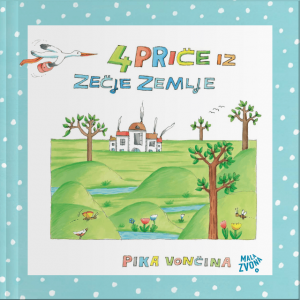
4 Tales from the Country of Rabbits

10,00 

In the county of rabbits the young reader will get to know the caring rabbit mom, dad who tells bedtime stories, their sons Eusebius the diary writer, Hugo the trumpet player, and other members of the large family, whose merry adventures are told in pictures interwoven with words. Texts by Pika Vončinahave an original ludic quality and often contain unobtrusive reflection about the natural world and human relations.

In the Direction of the Beginning (Early Short Stories)

10,00 

A collection of twenty short stories written simultaneously with the first poems that made the fame of Dylan Thomas. Creating his dense web of images, the young author is dealing (not without irony) with the big issues, life and death, love and madness, interweaving Welsh countryside and motives of local legends in impressive texts that defy all categorization.

Out of the Atelier

10,00 

New poetry collection by Sanja Lovrenčić.


still life: frozen begonias

brush captures the moment:
the stem still looks solid
ice in its heart makes it
apparently alive
while the sun is shining fervently
upon deep-frozen world

you see in the background:
someone left open
the veranda door
in the coldest night

malicious master painter in the picture
on a piece of auxiliary something
delivery box perhaps in which arrived
everything that’s crammed in the corner
is painting the rotting the gray the weary
plants as they will be
in only a few hours –

but not yet

The Pursuit of Winter

10,00 

The Pursuit of Winter is the first text that a renowned Croatian poet wrote for children. The plot is triggered by the (unspoken) question: “Could something lovely become boring?” It obviously can, if it is only and always lovely, especially if the thing we are talking about is the weather.  The picture book takes the reader – along with the animal protagonists, squirrel, wolf, deer, ants and birds – on a journey toward something absent but desired. And the miracle resides in the possibility to join forces and bring about the (unlikely) change.

The illustrations by Mingsheng-Pi make a perfect counterpoint to Kirin’s laconic and lyrical text. The illustrator received a Special Mention of the “Grigor Vitez” Award.


Age: 4-6


How Wang-Fo Was Saved

10,00 

How Wang-Fo Was Saved is one of a very few texts for children written by the great French novelist Marguerite Yourcenar, here translated into Croatian for the first time. In her story, inspired by a Chinese legend, with a master painter as the main protagonist, Yourcenar is posing fundamental questions about humanity and art in a simple, yet striking manner. Searching for the aesthetic pleasure the perfect master Wang-Fo discards the material world and its acclaim. However, an encounter with the Emperor reminds him that works of art are always about the world and part of the world – even if they eventually succeed in becoming a world in their own right and a sort of sanctuary.


Age 12+

Entrepreneurs

10,00 

The short novel Entrepreneurs by Mathias Nawrat, one of the most interesting voices of the new generation of German writers, can be situated into the dystopian tradition of the science-fiction genre with elements of social criticism. The story is happening in a well-known world, labeled by the geographical toponym Schwarzwald; however, this world underwent a certain kind of apocalypse – about which nothing is said explicitly, but we guess it had something to do with nuclear power – and the rules of an advanced technocratic society do not function any more, although they are not totally suspended. Through this fragmentary world, where nature, technology and waste interlace and form grotesque figures, roams the protagonist and narrator Lipa, a thirteen-year old girl. With her father and brother she collects different kinds of toxic leftovers while calling this activity entrepreneurship. The life of her family, in unstable balance on the edge of poverty and danger, is approaching the inevitable catastrophe.

Berlin Childhood around 1900

10,00 

Over the last few decades Walter Benjamin has become one of the most prominent names in the humanities: considering definitions of modernity, film theory, philosophy of history, cultural studies or criticism of canonical literary texts, his work can hardly be avoided. This is brought about by Benjamin’s broad interests and lucidity, but also by his awareness of the fact that cultural theory or philosophy always implies an act of writing. His penchant towards the use of metaphor, image, allusion rather than systematical argumentation and his insistence on a purified stile rather than a strict composition make Benjamin’s texts – that always place themselves between philosophy and literature – a field of knowledge that never allows an unambiguous interpretation. In his Berlin Childhood around 1900 the dominant element is precisely this ‘surplus’ of literature; applying an autobiographical discourse, Benjamin creates a lyrical picture of his childhood in a rich bourgeois family from Berlin. Nevertheless, this seemingly personal thematic becomes a historically relevant document that bears witness to the life and culture of the big city, evoking a great number of social and philosophical issues: the constitution of subject through memory, the shadow of class struggle, the possibility of objective historical representation, the relation between modernism and messianism. Starting from a specific literary genre, Berlin Childhood around 1900 amplifies the tension between philosophy and literature, the tension that makes them both possible: thus Benjamin anticipates some of the most important themes and techniques of post-structuralism, and stays as modern as ever.

Zagreb Childhood in the Sixties

10,00 

Sanja Lovrenčić wrote the book of prose fragments entitled Zagreb Childhood in the Sixties while she was working on the translation of Walter Benjamin’s autobiographical Berlin Childhood around 1900,and her writing is therefore marked by an interesting duality. Zagreb Childhood functions as an autobiographical discourse and deals with the elements typical for that genre: introspection, sketches of the chosen period, a fine nostalgia for childhood, which an adult can reach only as a selection of fragments that can never be made into a coherent whole; those elements could be labelled as personal and local. On the other hand, however, the book is a response to a literary text, a reaction not to a childhood or a social change, but to a certain type of writing. This leads to a completely different set of ideas, that we might call inherently literary – intertextuality, the fictionalization of the self, the use of poetic language and lyrical fragments that simultaneously connote and transcend personal experience. Thus Zagreb Childhood combines two elements that are necessary to make a quality literature: inclusion in the local context, as well as its constant dissolution – both intimacy and universality.

Gvalup and Other Stories

10,00 

A girl riding a hare, a boy taking off to an adventure with a walking carob tree, a barge that riots against its crew, a little fawn adopted in an elfish family, a statue that decides to live near a pond, a star that falls from the sky before its time – Tamara Bakran’s stories are as varied as are her heroes. Little episodes from the everyday life of a child suddenly take a fantastic turn – a little girl crying that the water for her hair wash is too hot may summon a fire brigade, and a jump into a puddle may lead into a fairyland. The originality and merry rhythm of these stories catch the reader’s attention and offer the kind of pleasure that is the basic prerequisite for creation of a lasting interest in books and reading.


Age: 6-9