


The Fly in the Atelier of Ivan Kožarić
How to introduce children to the world of a famous conceptual artist? The author of the text chose a character from the artist’s notebook, a little fly. Accidentally it enters the atelier – where all objects are wrapped in paper (the situation taken from real life). One by one they unwrap themselves for the little fly, telling and singing their stories. The illustrator creates the magical space of the atelier with highly original inventiveness, masterfully inserting citations of Kožarić’s works.
Book #3419

Safe Journey
Beatrice Masini and Gianni De Conno, the award-winning Italian tandem, communicate in this picture book the artistic and emotional experience of travelling. The combination of magnificent oneiric images and the poetic prose takes us on a journey into the unknown: sometimes the destination is known, and sometimes the trip is just aimless wandering; sometimes we encounter obstacles and surprises, sometimes “treasures we don’t know yet of.” Every journey is a unique experience; and the insights we gain, the feelings we go through, and the memories we create are its precious consequences. Attractive illustrations and suggestive short sentences stimulate imagination and their dreamy quality has won numerous readers; in 2018 Beatrice Masini and Gianni De Conno received the most prestigious prize in the field of children’s literature “SuperPremio Andersen”. For the great Gianni De Conno, this picture book marked the end of a life’s journey; it is the last and farewell gift he left us before his untimely death.
Book #3340

We, the Mice
“We, the Mice”, a new picture book by Pika Vončina, is a sequel to her series of picture books about a fantastic animal world. Four stories about a harmonious family of mice are told by Erik the Unstoppable, the mouse who got his nickname because he constantly asks curious questions. His family does not live in “holes” but in nice and comfy dwellings, eating a variety of fruits and vegetables (sometimes even cheese!), loving music and gardens…
The text is handwritten in large block letters, which allows younger children to read it on their own, and helps them as an additional motivation in the process of learning to read and write. The diversity of characters and settings stimulates the development of children’s imagination and deepens their perception and emotional intelligence.
Ages 4-7

Six Walks of Slava Raškaj
This picture-book is the first within a series with which Mala zvona introduces works of great Croatian visual artists to children. The famous Croatian impressionist painter S. Raškaj was deaf – and very sensitive to nature. Therefore, the writer of this picture book chose to represent her life and work in six walks with easel in different surroundings: the garden of her childhood, parks in the city where she learned to paint, winter woods and summer meadows where she made her best pictures. The illustrator did not copy the style of watercolors made by S. Raškaj, but gave the adequate transparence and lightness to his own.
Book #3338

Once
In this extraordinary picture-book the story keeps returning to its beginning. At every page, Igor Rajki starts out with the classical formula “Once there was a…”, only to interrupt the narration and turn to something else. The little sketches created in this way as well as the reasons the author offers for never finishing any of his stories finally build up to a hilarious mosaic of anecdotes while constructing a somewhat nervous but highly entertaining narrative voice. The visual artist Krešimir Zimonić responded to the fragmentary narrative style by using techniques of collage which combine drawings, photographs, graffiti styled writings and “ready-made” visual material. Once is, for this reason, a thoroughly sketchy and incredibly rich little book.

Paintings
Paintings, a collection of prose poems, brings Segalen’s descriptions of imaginary Chinese visual art: thereby a dialogue is opened not only between different cultures, but also between different artistic media. The reader wanders around these foreign, strange places, sometimes lost, sometimes amazed but is always lead forwards by Segalen’s virtuoso writing.
Mala zvona brings the first integral Croatian translation of this poetic masterpiece.

Flush: a Biography
How would a dog perceive the Victorian era? What would be this dog’s attitude towards his mistress – the great poet Elizabeth Barrett Browning? What happens when a biographical content is treated from a purely fictional perspective? These are the questions posed, and answered, in the short novel Flush; a Biography. In this playful, seemingly frivolous but very lucid, stylistically flawless text, Virginia Woolf is dealing with the issues of history, society conventions and social justice, while exploring in the extreme the possibilities of rendering of the perceptual perspective of an animal.

Cats
In Cats, the author offers several connected tales: a brave cat Mortimer goes to the sea to see the great white shark (meeting on his way the dangerous mister Darkly); a company of wandering acrobat-cats falls apart because of a very strange problem; Zigfrid and Zelda, brother and sister, practice the skills of measuring and sewing in their own way; and cat chefs, Leonard and Edgar are making pancakes for all of them.
Age: 4-6

Plastron, Pericardium
The third book of poetry by Lidija Dujić, Plastron, Pericardium, includes five cycles of poems: Growers of Ice, The Time of the Desert, A Plate of High Tide, Wagon Tracks and Crop Rotation and Bunker of Angels. It is a poetry full of daring images, unusual associative sequences, rich with references to various fields of human experience. Combining elements from different language levels, the (erudite) author shapes and produces her poetic reality, with its own optics and artistic logic.

The Voyage of Aunt Hilda
Hilda is an adventurous chicken (rare thing in a chicken house); she embarks on a long journey, searching for the river Limpopo. Her adventures are told in words and pictures, in a series of postcards that she sends to her friends who have stayed home (as a normal chicken should). Her postcards are never just landscapes; the picture always shows someone she met on the road: two ladybugs who lost their sister, a pig prince, a walking hill, a cat teacher teaching only the letter A, and a number of other characters whose stories she tells in just a few words. They make a pleasant reading, full of little surprises that excite wonder and laughter.
Age: 4-6

The Story of Golem
Drawing on the Jewish visual and literary tradition, Melita Kraus rewrites the legend of Golem of Prague, highlighting its fantastic and amusing side: funny episodes, caused by the fact that Golem’s creators succeeded in making him alive and strong, but not very bright, make the story lively and full of surprises. Placing the frame story (about a little boy who gets lost in the old Prague) in the present time, and narrating in a simple and contemporary language, Melita Kraus establishes a close relationship with the young reader, and draws her/him into the world of her imagination.
Age: 6-8

Letters to his Wife 1914-1917
My dearr heart, my lovely little one – thus begin the gentle letters Henri Barbusse wrote to his wife a hundred years ago. What follows is by no means gentle – trenches, shells, mud and the dead, the war that is revealed in its bloody meaninglessness. In the year 1914. the writer of letters, Henri Barbusse, was 41, had a reputation as a writer and editor, was not in the best health and had firm pacifist beliefs. Despite all this he volunteered for the French Army and spent the two first years of war on the front lines – and wrote his novel Under Fire, literary testimony of the World War I, which earned him the Goncourt prize and thousands of readers. Documentary material on which is based his novel is found in the letters he wrote almost daily to his wife Hélyonne. In their immediacy and authenticity, those letters can convey to the reader of today the drama of the beginning of the “short twentieth century” better than any fiction.
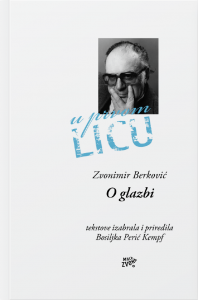
On Music
A collectionof music critiques and essays by Croatian film director and erudite Zvonimir Berković. Texts he wrote over several decades for newspapers and magazines are collected in this book and divided into four parts: Critique – Portraits – Meditations – Conversations. Collected and edited by Bosiljka Perić Kempf.
Zvonimir Berković wrote about music only occasionally, in the mid sixties and the first half of the seventies, for several newspapers and magazines. He left chronicles of the music lives of festival cities as Dubrovnik and Vienna, but he also wrote reviews of both local and foreign artists’ performances during the Zagreb concert season. Most interesting, however, are the author’s imagination and subtle (and not only musical) taste in the portraits of musicians, interpreters and composers. Music had a deep impact in Berković’s work of movie director, especially in his “Rondo”, a Croatian classic made in 1966.

Searching for Ivana
A biographical novel by Sanja Lovrenčić about the Croatian author Ivana Brlić Mažuranić. Written in the first-person singular, the story develops on two levels, in the past and in the present, unfolding around the changing and yet unchanging topics of family relations, artistic creation and female existence in the world of literature.
“K.Š.Gjalski” Award for the best Croatian novel in 2007.

A Hounted House
A collection of short stories by Virgina Woolf, first time in Croatian translation.
Translated by Sanja Lovrenčić
Kikop Award for the best literary translation in 2012.