• 0 Knjige - 0,00 
    • Košarica je prazna.

We, the Mice

12,00  7,20 

“We, the Mice”, a new picture book by Pika Vončina, is a sequel to her series of picture books about a fantastic animal world. Four stories about a harmonious family of mice are told by Erik the Unstoppable, the mouse who got his nickname because he constantly asks curious questions. His family does not live in “holes” but in nice and comfy dwellings, eating a variety of fruits and vegetables (sometimes even cheese!), loving music and gardens…

The text is handwritten in large block letters, which allows younger children to read it on their own, and helps them as an additional motivation in the process of learning to read and write. The diversity of characters and settings stimulates the development of children’s imagination and deepens their perception and emotional intelligence.

Ages 4-7


The Cabinet for Sentimental Trivial Literature

12,00  7,20 

Shortlisted for the Predrag Matvejević Award 2021, longlisted for the Fric Award 2019 Sanja Lovrenčić’s books draw into her net a reader who is ready for adventure, for whom reading is not merely following a linear plot and a pastime, but recognition and acceptance of a game that, when joined, becomes infinitely meaningful, subtle and even fun. Her new novel, entitled Cabinet for Sentimental Trivial Literature, in which is its set, but which is also an indicative determinant of what will be told, is certainly one of the “more readable” of her novels, i.e. one in which there are no traps for readers, unless they themselves want to fall into them. Also, as is often the case with this author, its structure is built somewhat conceptually, by changing the epistolary form, which makes up the main flow of narration, with inserted stories that form a rounded and meaningful whole it. There has been a crisis in the Cabinet, which is a kind of small, private and non-profit museum that houses the legacy of “sentimental and trivial literature”. The curator, who writes letters to the late founder Rosa, realizes that not only does the Cabinet need a “cash injection”, but also a new guardian to replace him. Since this is not just an ordinary job but also has a specific emotional and, of course, sentimental value, neither is easy to perform, and a job advertisement that includes one of the key sentences of the novel: “Your story is more important to us than your qualifications”, will further complicate matters. (…) Ten candidates apply to the ad that had inadvertently implied that candidates should also be writers, and they bring with them stories about their professional and private lives, sometimes completely bizarre, but also stories that make up an integral part of the novel. While the curator, who is becoming more and more desperate and sceptical, fills letters to Rosa with fragments from his own and the Cabinet’s everyday life, as well as those concerning the past, origin and meaning of her and his museum, an unusual and “soft” legacy that seems to have been run-over by a time of different imperatives  and priorities, the candidates succeed one another before him, with their experiences, but above all with the stories they enclose, enabling the novel to emerge from the closed space of the Cabinet into the outside, towards modernity and its peculiarities and problems. This “opening” – placed in stories within the story – subtly positions the novel towards recent reality, because it indirectly deals with the themes of art and artistic activism, social responsibility, commercialization and the entry of capital into unprofitable spheres of human activity, feminism. science and technology, but also love, which is one of the shared motives and concerns both interpersonal relationships and the preservation of some past values. (Jagna Pogačnik)

Sketching out a Heroine

12,00  7,20 

As a poet of proven skills, Sanja Lovrenčić sketches a mysterious heroine. Who is she? After reading, it is up to us to conclude. Or to let her continue to take shape within us for a long time. For, this collection of poems counts on the cooperation of a careful watcher and listener, a curious reader sensitive to language and its beyond. Sanja Lovrenčić invites us on an adventurous poetic journey through the poems/episodes of a very special, never fully expressible or sharply drawn protagonist, with whose joys, doubts, insights and resignations we easily empathise. (Dorta Jagić, ed.)

Longlisted for the Kamov Award 2021

The Story of Golem

13,00  7,80 

Drawing on the Jewish visual and literary tradition, Melita Kraus rewrites the legend of Golem of Prague, highlighting its fantastic and amusing side: funny episodes, caused by the fact that Golem’s creators succeeded in making him alive and strong, but not very bright, make the story lively and full of surprises. Placing the frame story (about a little boy who gets lost in the old Prague) in the present time, and narrating in a simple and contemporary language, Melita Kraus establishes a close relationship with the young reader, and draws her/him into the world of her imagination.


Age: 6-8

Flush: a Biography

13,00  7,80 

How would a dog perceive the Victorian era? What would be this dog’s attitude towards his mistress – the great poet Elizabeth Barrett Browning? What happens when a biographical content is treated from a purely fictional perspective? These are the questions posed, and answered, in the short novel Flush; a Biography. In this playful, seemingly frivolous but very lucid, stylistically flawless text, Virginia Woolf is dealing with the issues of history, society conventions and social justice, while exploring in the extreme the possibilities of rendering of the perceptual perspective of an animal.

Piccola con piccolo

13,00  7,80 

The little girl Piccola shows an unusual feeling for sounds. Imitating the chirping of birds, the crackling of fire, the sounds of the wind and everything else that surrounds her, Piccola amazes the listeners singing her little melodies. When she comes to a
music school and old Professore starts teaching her to play the piccolo, the smallest girl with the smallest flute becomes ‘Piccola con piccolo’; her Bird Music becomes a huge success and she is invited to perform all over the world. Piccola con piccolo
is the first picture book written by Bruno Mezić. Creating a likable character of the little girl Piccola,
telling about her adventures in sound, and skillfully playing with Italian words, the author introduces young readers to the terminology of classical music. Illustrations by the young visual artist and designer Klasja Habjan imaginatively and playfully follow the text and bring to life the original little heroine and her music.


Book #3705


Heroes and Dragons on the Decline

13,00  7,80 

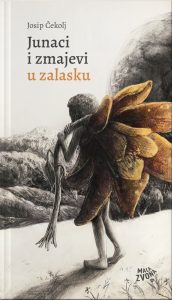
Imagination and a certain freedom in his relation to language as well as an authentic poetical experience characterize Josip Čekolj’s first poetry collection. In four parts – four zeals – the lyrical voice of this young and talented author celebrates the novelty of his first worlds, from the home region, both in a concrete and a symbolic form, to the world of family and first loves. The magic of these poems mostly arises from the peculiar shifts from real to surreal, from bright images that depict an underlying emotion. The author builds his space of words, a space that is built from moments he has experienced. This space is often related to motives that originate in nature and in traditional culture, but it is consistently original, full of surprises and freshness.

All My Loved Ones But Me

13,00  7,80 

Luka Mavretić’s third poetry collection “All My Loved Ones But Me” is a series of “inner journeys” – journeys that the author announces in the first poems of this very thoughtfully built piece. The young poet balances between lyrical verses and prosaic sentences, he strives towards a refined simplicity and manages to create a conversational tone, which is an important building block of his poetical world. An abundance of motives and a diary-like directness make this book an interesting and fresh collection. Even though he uses interpunction which creates finished, harmonical sentences and gives the text a prosaic tone, his verses remain verses, lines with a natural and easy flow. Despite a breezy atmosphere that the author creates, this is a collection of well thought-through and refined texts – Luka Mavretić is a poet who, in an alchemy of words, transforms chosen glimpses of reality into memorable and luminous images.

Feminine Side of the Croatian Literature

14,00  8,40 

Exploring the feminine side of Croatian literature Lidija Dujić offers a concise and interesting overview of selected segment of the Croatian literary historyShe gives biographial sketches of Croatian female writers, explores the reception of their work and cliche images of women writers from the times of Renaissance to the contemporary age.  Analyzing and re-valuing some works, recognized under the label of “women’s literature”the author challenges many commonplace notions  writing in first person singularThe book is based on her doctoral dissertation, but is intended for a wider audience.

Safe Journey

14,00  8,40 

Beatrice Masini and Gianni De Conno, the award-winning Italian tandem, communicate in this picture book the artistic and emotional experience of travelling. The combination of magnificent oneiric images and the poetic prose takes us on a journey into the unknown: sometimes the destination is known, and sometimes the trip is just aimless wandering; sometimes we encounter obstacles and surprises, sometimes “treasures we don’t know yet of.” Every journey is a unique experience; and the insights we gain, the feelings we go through, and the memories we create are its precious consequences. Attractive illustrations and suggestive short sentences stimulate imagination and their dreamy quality has won numerous readers; in 2018 Beatrice Masini and Gianni De Conno received the most prestigious prize in the field of children’s literature “SuperPremio Andersen”. For the great Gianni De Conno, this picture book marked the end of a life’s journey; it is the last and farewell gift he left us before his untimely death.


Book #3340

A Short Trip Home and other Stories

14,00  8,40 
Book #3328


Dormitory

14,00  8,40 

Although it could seem that the primary origin of this poetry is the world of words – the author recurrently affirms the experience of reading as something very much alive and inspiring – the contact with her own material environment is equally important for Lidija Dujić. And no matter how linguistically complex, surprising, metaphorical this poetry is, and how far it takes (ironic) distance from reality, it always remains tied to the real moment that triggered poetic imagination and caused poetic language to flow. Singling out some moments, turning flashes of reality into a thoughtful linguistic structure, the poet creates original and meditative images, with a clear awareness of poetry as non-ordinary speech.

Point Nemo

14,00  8,40 

Mladen Kopjar is an author with extensive experience in writing different types of literary texts. In “Point Nemo”, his first collection of poetry, this experience is reflected in the ease and skill with which he builds his poetic world, as well as in his thoughtful and consistent poetics. The origins of the poems are usually in everyday life, its spaces, objects, small events, memories, but thanks to the gift of observation and skillful selection of details, the author skillfully avoids the superficiality and banality of “realistic” writing. Freedom and imagination lead him from concrete experience to surreal images in which personal associations are mixed with various fragments from the ubiquitous virtual space. But the unique tone of this collection stems from the deep emotionality with which the whole is imbued; the author addresses (or talks about) his loved ones: wife, child, parents, meandering through areas of tenderness and pain. In that intimate space, the outside world is mirrored in flashes; the original clash between an authentically, intensely internal world and a diverse, sometimes aggressive external world gives this poetry strength and interest.

Six Walks of Slava Raškaj

15,00  9,00 

This picture-book is the first within a series with which Mala zvona introduces works of great Croatian visual artists to children. The famous Croatian impressionist painter S. Raškaj was deaf – and very sensitive to nature. Therefore, the writer of this picture book chose to represent her life and work in six walks with easel in different surroundings: the garden of her childhood, parks in the city where she learned to paint, winter woods and summer meadows where she made her best pictures. The illustrator did not copy the style of watercolors made by S. Raškaj, but gave the adequate transparence and lightness to his own.


Book #3338


The Fly in the Atelier of Ivan Kožarić

15,00  9,00 

How to introduce children to the world of a famous conceptual artist? The author of the text chose a character from the artist’s notebook, a little fly. Accidentally it enters the atelier – where all objects are wrapped in paper (the situation taken from real life). One by one they unwrap themselves for the little fly, telling and singing their stories. The illustrator creates the magical space of the atelier with highly original inventiveness, masterfully inserting citations of Kožarić’s works.


Book #3419