


Zaboravljene stvari
17,00 €U umjetničkoj autorskoj slikovnici, namijenjenoj publici svih generacija, Agata Lučić vodi čitatelja na sajam starih stvari. To je monokromatski plavi svijet u kojemu se nižu raznoliki predmeti, zajedno sa svojim pričama. Svaki u sebi nosi tragove vremena provedenog u nečijem životu, tragove nečije prošlosti. Virtuozan i vrlo prepoznatljiv stil mlade likovne umjetnice iz stranice u stranicu dočarava fragmente života koje su „zaboravljene stvari“ dijelile sa svojim ljudima i tako stvara originalno, pomalo čudesno, toplo ozračje. Posljednja duplerica donosi iznenađenje: u trenutku kad stvari uspiju privući nove ljude, postići da prihvate i njih i njihove priče, u slikovnicu prodiru boje. To više nije prostor sjećanja, nego prostor života. Ova likovno izuzetno inventivna slikovnica, i nostalgična i vesela, očuđuje najobičnije predmete, poziva na otvaranje prema tuđim, nestalim pričama i nekim vrijednostima dostupnim samo pažljivom pogledu. Pristupačna djeci, poziva i odrasle čitatelje na sanjarenje, nudeći nedvojben vizualni užitak.
Book #4876

The Lives of Troubadours
10,00 €Sanja Lovrenčić’s book presents biographical texts by anonymous authors from the 13th and 14th century that depicted the lives of troubadours. Medival biographical texts about troubadours are a very old testimony about the interest that lives of artist awakened in their contemporaries. In a time where the only biographies written were those of saints and important rulers, poets are the only group of people that defy that rule – by being written about. Their biographies were written in a language that in medieval times, among others, was called “lenga d’oc”. Today this language is mostly referred to as Occitan, and it is considered to have been Europe’s first literary language after the classical period.

In the Rhythm of Horror – The Abyss of Dances
13,00 €“In the Rhythm of Horror – The Abyss of Dances” is a collection of six fantasy stories by young Croatian authors. The stories were chosen via a competition that Mala zvona held in 2020, after which authors Josip Čekolj, Mateja Pavlic, Marin Pelaić, Ines Vajzović, Martina Vidaić and Orin Ivan Vrkaš were chosen. Except for the characteristic fantastical elements of the unexpected and wondrous, the motive of dance also connects the stories – a dance of the dead and the arisen, a dance of half-humans and half-animals in the moonlight, an oriental dance of wraiths in black capes. These obnoxious dancers contribute to an uneasy atmosphere but at the same time, they create an aura of mystical beauty. Each story is illustrated with a black and white piece by Klara Rusan Klarxy – her work masterly depicts the merge of the real and the otherworldly, and makes a world that might seem dark and bizarre mysteriously alluring.

Silences
10,00 €In this book that addresses every generation words and images blend into an impressive poetical unity. Using drawings with simple, clear lines and concise sentences, the author tells a story that’s possible to read and experience on different levels. She talks about the close connection of human beings with nature, about changes and the importance of that – sometimes concealed, but still permanent – relationship. The tree is also a symbol of the author’s inner being, a deep and vital center where her strength arises from, a strength of the utmost importance in encounters with the outside world and collisions with its walls.
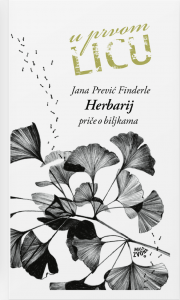
Herbarium – Stories of Plants
11,00 €Jana Prević Finderle’s “Herbarium” could both be seen as a follow-up to her debut “The travertine bridge”, published in 2019, and its sheer opposite. One could argue that it’s a follow-up, because it is a book of short prose inspired by the author’s own experiences, delivered in a simple and direct way – and that it’s an opposite, as “The travertine bridge” was dedicated to travels and encounters, a horizontal motion through space, while “Herbarium”, a book about the lives of plants and the people closest to the author, focuses on travelling vertically, through time. For every herbarium, including Jana’s, is a book of memories. It seems that we live in times of increased sensitivity for the green world that surrounds us, a world that is getting more endangered with every day. But Jana’s soft spot for plantlife isn’t a result of any trend, although the need to create a herbarium made of words could have been influenced by the increasing eco-awareness in times of global warming. This author has, since early childhood, been living her life in close connection to plantlife, which enables her to talk about it from a personal, almost lyrical, perspective. Her authentic language depicts a simple closeness. The focus doesn’t lie on a problem or on the author’s knowledge of botany – which she clearly has – but rather on her personal experiences, her discoveries, little miracles she encounters, like the ones where her aunt Mirjana, in Jana’s adolescent days of spleen, tells her about an acorn and an oak.

A River Certainly does Love the Flood
10,00 €In her first poems Sanja Lovrenčić distanced herself in an elitist manner from the descriptiveness of reality and its usual subjects, but now in the collection A River Certainly does Love the Flood she approaches them in a relaxed manner equipped with elements of fairy tales – dreaminess, flax-ness and cotton-ness. Suddenly, for her, everything is utterable, without the pronounced use of the notional labyrinth or the figurative debris prominent with some other writers (…) Sometimes she would reach for the images that are close to a child’s concept of the world. Naturally, it is only an excuse. We are dealing here with a skilful mimicry of childlike tameness and imagination by the complexity and even aggression of adulthood. For our times, the author is really a gentle poet (but not a coy nor a complaining one) who by no means wants to use parasitic additions to make beauty, but neither does she want to use those purely technical, artificial means with “witchcraft” intentions. She is interested in a “walk with pebbles”. In all probably this is what contributed to her being the laureate of the Kiklop Award for the best poetry collection in the year 2007. (Sead Begović)
Kiklop Award for the best poetry book, 2007.


Courts of Heaven and Waters of Earth
11,00 €In this book the author, who has already addressed the folklore heritage in various ways, created a vision of a lost world, the customs and beliefs of an ancient people “who herded cattle, spoke some Proto-Slavic language and did not use the alphabet”. Although based on contemporary ethnological knowledge, the stories collected in this book are told in a personal, poetic style, in different voices that seem to appear before readers from the depths of time and guide them through their universe. Portions of ancient folk songs that reflect fragments of forgotten beliefs are also woven into the author’s text. (Anita Peti-Stantic)
Intended for children over 12 and adults.

Notes on the House, Notes from Absence
14,00 €The text of these Notes flows like a mountain stream or breeze: it describes scenes from writers’ residences in which the author stayed for a little over a year, and the reflections associated with these places make up the bulk of the book. These are notes about the journey, woven with the subtle skill of a top connoisseur of language and working with words. Atmosphere, associations and images are innumerable; thoughts, questions – we recognize them all, we ask ourselves all that. But here and there, as when the folds of a fabric are separated by a gust of wind, readers see that this is not all: from the notes made between the trips they catch hints of the horizon of harsh and stupid reality that led the author to go on the road again and again. “You cover reality with a veil and you see better,” she writes in this book. Traveling with clear thoughts and open eyes, Sanja Lovrenčić covers and reveals reality with a unique fabric woven of words. (Iva Valentić, ed.)

Marija in Cities
16,00 €Marija in Cities belongs to the series of Sanja Lovrenčić’s picture books about Croatian visual artists; this one is about the well-known photographer Marija Braut. The story about her is told from the viewpoint of her inseparable companion, the analogue camera, which directly and simply reports on their shared travels and work, the motifs of Marija’s photography, and her feeling for people and spaces, which the camera sometimes shared with the artist, and at other times just longed for calm scenes that are easier to capture. This is a lyrically intoned, very subtle depiction of the artist’s life and work, filled with a vestige of nostalgia for the great age of analogue photography, but also with hope in its preservation. In addition, the author offers the young readers an easy-to-understand introduction to the basics of this art technique.(Adrian Pelc, ed)
Book #4896

The Magic Eyeglasses
16,00 €Sophia, the little heroine of this story, wants to help her mother to bake a cake. Mom tells her to fetch the cake pan from the storage room, but Sophia is afraid of that dark space – she’s so afraid that she doesn’t even dare to stretch her arm to turn the light on. But then comes her dad and gives her a pair of special eyeglasses – eyeglasses that make the world look different. And more than that! They not only change the look of things in darkness, but also give the person wearing them the ability to talk with animals. Looking through the magic eyeglasses, Sophia meets a spider in the storage room and a moth in her bedroom. As she opens a window, she sees a weasel and a saturnia moth in the garden. Her encounters with these creatures show that beings who look nice are not always nice – and vice versa. This warm and breezy story teaches young readers self-confidence, the importance of getting to know someone before making a judgment, as well as the fact that first impressions are not always reliable.
Book #4906