-
 The Sneering Bird
× 2
The Sneering Bird
× 216,00 €9,60 €
Ukupno : 19,20 €

 The Sneering Bird
Ukupno : 19,20 €
At first glance, the Moon seems to be the central character of these “twelve stories for daydreaming”, but various other characters alternate under its shine and go through many unexpected experiences: under its light, snow owls hold their annual ball, it serves the little fairy as the highest jump in the sky, a mouse will use it as a model for a picture of the ideal cheese… When it disappears from the sky, four cats go in search of it, and when it reappears it will serve as a swing for three crazy dogs, winners in howling competition… (illustrated by Pika Vončina)
Six stories from the world of folk lore, selected, translated and adapted for performances for and by children.
Croatian national award for books for children “Grigor Vitez” 2010
Diaries by the famous Croatian writer Ivana Brlić Mažuranić, written in the 1880s when she was fifteen to eighteen years old. The book provides insight into teenage life in the 19th century in Zagreb, the charming young character of the writer, her thoughts on literature, life and death, as well as the seeds of conflicts awaiting a female writer – all of which makes it a highly interesting read.
How to choose a profession? This fundamental question is treated in quite an unusual way when a girl decides to be “a girl from the circus” – and gives good reasons for her decision. The girl’s mother gives examples of professions with the same advantages, but Irene finds a way to follow her dream.
Playing with the motives of Andersen’s “Little girl with the matches” Melita Kraus tells the story about a little she-dog named Lili, whose old master got ill and had to go to the hospital – on the Christmas Eve. The little dog is left alone and tries to win someone’s attention, but nobody cares for her. Very tired and hungry she rambles through the town, until she is too exhausted to continue. She lies down and sees – in a dream – her dog-parents. They give her advice – to knock at the door in front of which she is lying…
Simply told and emotional, ideal reading for the young children (+3).
Hilda is an adventurous chicken (rare thing in a chicken house); she embarks on a long journey, searching for the river Limpopo. Her adventures are told in words and pictures, in a series of postcards that she sends to her friends who have stayed home (as a normal chicken should). Her postcards are never just landscapes; the picture always shows someone she met on the road: two ladybugs who lost their sister, a pig prince, a walking hill, a cat teacher teaching only the letter A, and a number of other characters whose stories she tells in just a few words. They make a pleasant reading, full of little surprises that excite wonder and laughter.
Age: 4-6
The third book of poetry by Lidija Dujić, Plastron, Pericardium, includes five cycles of poems: Growers of Ice, The Time of the Desert, A Plate of High Tide, Wagon Tracks and Crop Rotation and Bunker of Angels. It is a poetry full of daring images, unusual associative sequences, rich with references to various fields of human experience. Combining elements from different language levels, the (erudite) author shapes and produces her poetic reality, with its own optics and artistic logic.
Leo is sitting in front of the house, lounging in a chair and thinking about the past year. The summer was great and promised a good start to seventh grade: with his brother and some friends he had founded a rock band that played a crazy summer hit, played in an international orchestra in Slovenia, and also, he had bathed in the sea. But when he returned to the city, things started going downhill – their pet, a brown rabbit, disappeared without trace, seventh grade started “badly”, with a pile of books, endless assignments and papers, and disagreement broke out with the new fencing coach … Sanja Lovrenčić enriched Croatian youth prose with a realistic and entertaining novel which, through the eyes of the smart, witty and talkative boy Leo, his family and friends, makes us aware (or reminds us) of the problems of growing up. Through the clarity of a child’s mind, we are faced with the absurdities of the adult world, as well as absurdities in schooling (very well described in the chapter “When you write about spring for the seventh time”). Adolescence has never been easy, but this novel shows that it can and should be fun!
(recommendation of the Vladimir Nazor Library in Zagreb)
In “Travertine Bridge”, the author Jana Prević Finderle, based on her own experience and memories, introduces us to the life of travelers and the world of travel. The short travel sketches act like original postcards addressed to the reader; a concise description derived from the author’s impression of a place, fellow traveler, or guest turns into a vivid picture before our eyes. From a modest summer vacation on the Adriatic Sea in early childhood, to somewhat later family car trips to Paris and London, to independent wanderings around the world in adulthood, the author’s text, sometimes humorous, sometimes melancholic, and almost always nostalgic, seems somehow familiar to us and encourages us to embark on an adventure ourselves. The text is accompanied by drawings by Mate Rupić, who skillfully and thoughtfully transferred some of the vivid moments of Jana’s stories to paper using the ink technique.
Famous letters by Mary Wollstonecraft for the first time in Croatian translation.
Six stories based on the tales from the Croatian folk lore, selected and adapted for children’s theatre performance.
Illustrated by Ana Kadoić.
“Lice knjige” Award for the best book cover design.
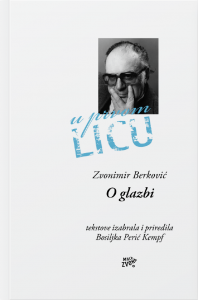
A collectionof music critiques and essays by Croatian film director and erudite Zvonimir Berković. Texts he wrote over several decades for newspapers and magazines are collected in this book and divided into four parts: Critique – Portraits – Meditations – Conversations. Collected and edited by Bosiljka Perić Kempf.
Zvonimir Berković wrote about music only occasionally, in the mid sixties and the first half of the seventies, for several newspapers and magazines. He left chronicles of the music lives of festival cities as Dubrovnik and Vienna, but he also wrote reviews of both local and foreign artists’ performances during the Zagreb concert season. Most interesting, however, are the author’s imagination and subtle (and not only musical) taste in the portraits of musicians, interpreters and composers. Music had a deep impact in Berković’s work of movie director, especially in his “Rondo”, a Croatian classic made in 1966.
My dearr heart, my lovely little one – thus begin the gentle letters Henri Barbusse wrote to his wife a hundred years ago. What follows is by no means gentle – trenches, shells, mud and the dead, the war that is revealed in its bloody meaninglessness. In the year 1914. the writer of letters, Henri Barbusse, was 41, had a reputation as a writer and editor, was not in the best health and had firm pacifist beliefs. Despite all this he volunteered for the French Army and spent the two first years of war on the front lines – and wrote his novel Under Fire, literary testimony of the World War I, which earned him the Goncourt prize and thousands of readers. Documentary material on which is based his novel is found in the letters he wrote almost daily to his wife Hélyonne. In their immediacy and authenticity, those letters can convey to the reader of today the drama of the beginning of the “short twentieth century” better than any fiction.
In Cats, the author offers several connected tales: a brave cat Mortimer goes to the sea to see the great white shark (meeting on his way the dangerous mister Darkly); a company of wandering acrobat-cats falls apart because of a very strange problem; Zigfrid and Zelda, brother and sister, practice the skills of measuring and sewing in their own way; and cat chefs, Leonard and Edgar are making pancakes for all of them.
Age: 4-6
Paintings, a collection of prose poems, brings Segalen’s descriptions of imaginary Chinese visual art: thereby a dialogue is opened not only between different cultures, but also between different artistic media. The reader wanders around these foreign, strange places, sometimes lost, sometimes amazed but is always lead forwards by Segalen’s virtuoso writing.
Mala zvona brings the first integral Croatian translation of this poetic masterpiece.
In this extraordinary picture-book the story keeps returning to its beginning. At every page, Igor Rajki starts out with the classical formula “Once there was a…”, only to interrupt the narration and turn to something else. The little sketches created in this way as well as the reasons the author offers for never finishing any of his stories finally build up to a hilarious mosaic of anecdotes while constructing a somewhat nervous but highly entertaining narrative voice. The visual artist Krešimir Zimonić responded to the fragmentary narrative style by using techniques of collage which combine drawings, photographs, graffiti styled writings and “ready-made” visual material. Once is, for this reason, a thoroughly sketchy and incredibly rich little book.