-
 Serna and Mack in Pursuit of the Frightened Month
× 1
Serna and Mack in Pursuit of the Frightened Month
× 115,00 €9,00 €
Ukupno : 9,00 €

 Serna and Mack in Pursuit of the Frightened Month
Ukupno : 9,00 €
The old cake lady is gone!
Roses aren’t blooming for me!
His axe struck honey!
Visual artist Petra Balekić interprets in her own way – using images and words – just some of the many coluorful expressions often heard in spoken Croatian. For those who know the language will be reminded od them and have a laugh, while those who don’t will be amazed and learn them with the help of the English translations – and thus avoid getting “tongue soup” for being ignorant.
Luka Mavretić’s third poetry collection “All My Loved Ones But Me” is a series of “inner journeys” – journeys that the author announces in the first poems of this very thoughtfully built piece. The young poet balances between lyrical verses and prosaic sentences, he strives towards a refined simplicity and manages to create a conversational tone, which is an important building block of his poetical world. An abundance of motives and a diary-like directness make this book an interesting and fresh collection. Even though he uses interpunction which creates finished, harmonical sentences and gives the text a prosaic tone, his verses remain verses, lines with a natural and easy flow. Despite a breezy atmosphere that the author creates, this is a collection of well thought-through and refined texts – Luka Mavretić is a poet who, in an alchemy of words, transforms chosen glimpses of reality into memorable and luminous images.
The story begins one January morning when the planet Saturn suddenly materializes in the big swimming pool, at first in a smaller version of itself. The unexpected event shakes up the sleepy routine of the regular visitors of the swimming pool called ‘Future’. Lacking logical explanations, but brimming with their own ideas, they try to adapt to the new circumstances, hoping the planet will go away on its own. Some try to extract profit from the event, others pretend that nothing is happening, but finally it becomes clear to them all that they simply have to kick out the constantly growing Saturn out of their pool while it’s still possible! This picture-book, fully authored by Vendi Vernić, one of the foremost Croatian illustrators of the younger generation, will appeal to readers of all ages. The story can be read and interpreted on multiple levels: as an absurdist game of imagination, as a little study of a specific community, or as an allegory on melancholy and depression.
The little girl Piccola shows an unusual feeling for sounds. Imitating the chirping of birds, the crackling of fire, the sounds of the wind and everything else that surrounds her, Piccola amazes the listeners singing her little melodies. When she comes to a
music school and old Professore starts teaching her to play the piccolo, the smallest girl with the smallest flute becomes ‘Piccola con piccolo’; her Bird Music becomes a huge success and she is invited to perform all over the world. Piccola con piccolo
is the first picture book written by Bruno Mezić. Creating a likable character of the little girl Piccola,
telling about her adventures in sound, and skillfully playing with Italian words, the author introduces young readers to the terminology of classical music. Illustrations by the young visual artist and designer Klasja Habjan imaginatively and playfully follow the text and bring to life the original little heroine and her music.
Book #3705
Biljana Romić, born in 1960, is a Croatian indologist and cultural editor. She gained her Master of Arts title in 1997 in Zagreb, with a study of Bharati Mukherjee and postcolonial migrant faiths. She has ever since actively been researching and writing about postcolonialism and the notion of the Other. Her extensive study The women’s world of British India was written after she spent several years studying diaries and letters written by “memsahibs”. Her work is not simply a historical overview of their lives and roles during colonialism, it puts colonial history, literature and the notion of the “Other” in a contemporary critical context; Romić analyses over one hundred and fifty sources, including Indrani Sen, Amandeep Kaur, Kumari Jayawardena and Shashi Tharoor. When reading about the British colonial venture in India, we mostly encounter works that have been written from the male perspective of conquests and regimen – but colonial women have, almost from the very beginning, been a part of this venture. Biljana Romić’s book brings us the voices of these women and their lives. They journeyed into the unknown, often not prepared for the adversities of a different climate and the social roles they were going to find themselves in. They went into the unknown as wives, governesses, teachers, as young women in search of a husband; sometimes as entrepreneurs, missionaries, adventurers. Many stayed within the expected roles given by the British colonial community, but some of them showed that it is possible to overcome the limitations of their era, class and gender when it comes to their relation to India and Indians. Biljana Romić talks about the so-called “little history”, the one that appears on the margins of big historical events – and without which it is impossible to gain a complete picture of a time that has passed.
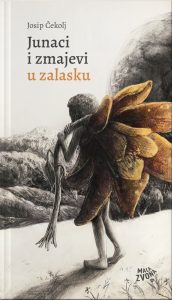
Imagination and a certain freedom in his relation to language as well as an authentic poetical experience characterize Josip Čekolj’s first poetry collection. In four parts – four zeals – the lyrical voice of this young and talented author celebrates the novelty of his first worlds, from the home region, both in a concrete and a symbolic form, to the world of family and first loves. The magic of these poems mostly arises from the peculiar shifts from real to surreal, from bright images that depict an underlying emotion. The author builds his space of words, a space that is built from moments he has experienced. This space is often related to motives that originate in nature and in traditional culture, but it is consistently original, full of surprises and freshness.
This gentle, cheerful and entertaining story will be engaging for all children of preschool or early school age. Its main character Dalibor thinks he has to be a “big boy” and throw away his childish stuffed animals. Left to their own devices, they manage as best they can, while Dalibor starts having an uneasy conscience… A series of humorous details, a wise lesson at the end and extraordinary illustrations by Vendi Vernić will make Bunny and Chick one of the favourite inhabitants of any child’s bookshelf.
After reading old Croatian folktales in a very serious book for adults,author Sanja Lovrenčić decided to set her favourite ones free and make them more accessible to children of today, telling them in her own literary voice, adjusting them slightly so that they would be more understandable. In eleven short tales, we meet a wide range of interesting heroes and antiheroes, from fox brides and tiny fairies to ravenous young women and mean bunnies. Set in magical and mystical forest settings skillfully depicted by Branka Hollingsworth, these tales – sometimes whimsy, sometimes not – now get to live on in the minds and hearts of new generations of young readers and listeners, saved from the terrible destiny of being forgotten.
In this picture book Croatian author Igor Rajki, winner of the prestigious Grigor Vitez award and the award of the Fairy tale festival of Ogulin, deals with a contemporary issue – the issue of the excessive presence of electronic devices and their screens in our everyday life. He does this in an original way, using his distinctive imaginative poetic language, kindling the readers’ imagination and making them think at the same time. The narrator of the story is giving, as if he were a professor of some kind, a lesson about ‘assembling of darkness in the dark’ – an enchanting phenomenon that occurs at the end of the day, in closed spaces, when darkness begins to descend from the ceiling and rise from the floor; the two darknesses embrace each other and slowly turn into the thick dark. But that is not all; during their game they create small sprouts, so called darklets. Darklets playfully twirl around objects, taming their shapes and leaving no trace. But when various screens start to interfere, a problem occurs: grayish shadows appear where darklets should be… The literary story about darklets is narrated in another, visual language by Klasja Habjan, a young illustrator and designer. She creates impressive, secretive life in spaces on the edge between night and day, spaces inhabited by fleeting human and animal figures, fragments of objects and fragments of their interactions; she does this with extraordinary inventiveness, on a very high aesthetic level, making this book attractive not only for reading but also for (repeated) viewing. By offering the youngest readers an utterly unusual visual experience, Klasja Habjan broadens the concept of what a picture book can be, and opens up the space of children’s book for new ways of artistic expression.
In 1934, Christiane Ritter, a thirty-seven-year-old housewife, mother of one child and a woman with some artistic education, set off for Svalbard – more precisely, for the northern coast of the island of Spitsbergen – at the invitation of her husband, a sea captain and a lover of the far north. She was equipped with everything that well-meaning people had advised her to take with her, but none of them knew exactly what awaited her at her destination. Sailing by ship towards the northern latitudes, she hid the ultimate goal of her journey from the other passengers, knowing that in the opinion of most, such an undertaking was not for a woman. Because, indeed, before Christiane, no woman from the so-called civilized world had dared to go to the harsh polar regions; they were associated exclusively with men, explorers, conquerors of the wilderness. However surprised and even intimidated by life in the Arctic wasteland at first, Christiane Ritter embarks on the adventure bravely. She adapts to a cramped hut, 250 kilometers from the nearest settlement, a dwelling that offers only rudimentary protection from the forces of nature, and tries to run a household for her husband and his assistant Karl. Often left alone – while the two men go hunting, fresh and frozen meat and offal forming the basis of their diet – she manages to cope with the physically demanding circumstances, fear and anxiety.
Even in such situations, her experience of the far north is dominated by admiration and awe of the surrounding natural world. Recording impressions and daily activities in words and images helps her cope with loneliness, and even with the deep, long-lasting darkness of the polar night. These notes will eventually serve as the basis for a book on which the author will work for another two years after returning home, trying to give a literary dimension to her experiences. She completely succeeded; she describes the Arctic world, its animal inhabitants and climatic specifics, the northern lights, the arrival of ice, the harshness of the rocky coast, the life of the minute summer vegetation in an extremely impressive way. Unlike other (male) reports from the polar regions, hers does not emphasize the enterprise and courage of explorers and hunters (although this is also mentioned), but rather the unearthly beauty of the far north and the effect of its extremes on the human psyche. Christiane Ritter’s book is considered a classic work of travel literature, and has been continuously printed in the original German language since 1938, when it was first published. It has been translated into eighteen languages and has also been highly regarded as a translated edition; this is the first translation of this book into Croatian.
This prose-poetry reader could prove to be one of the key events of the Anglo-Croatian literary exchange in 2025: in it, translator and poet Goran Čolakhodžić brings a selection of prose and verse by the English early modernist, Edward Thomas, one of the most important voices of British poetry and of the generation of artists who perished in the Great War, and a close friend of the American classic Robert Frost. The rhythms of his verse are quiet and unobtrusive; he was above all a poet of the earth, trees, birds, and the human relationship with nature, but his poetry is also characterized by subtle psychological insights and is overshadowed by the coming world conflict. In addition to tackling Thomas’s rhymed verse and selecting some of the most successful fragments from Thomas’s nature writing, travel journals and articles, Čolakhodžić also wrote a critical preface, notes and his own artistic text juxtaposed with Thomas’s – a diary of the arrival of spring in Zagreb in 2025, which highlights the similarities and differences between England and Croatia, the 19th and 21st centuries, reminding us of the impact that climate change and people’s problematic relationship with nature have on our daily life. The painter Iva Valentić provided stunning artistic responses to the texts collected here, connecting Far Eastern techniques with Western literature.
Direct contact with nature plays an important role in this little poetic and visual trilogy by two authors, Sanja Lovrenčić and Iva Valentić. Each in her own way, they experience the green worlds – even if those worlds are small, squeezed between concrete and asphalt – as spaces for a silence that is a departure from everyday reality and a prerequisite for creative work. The Silence of Green was originally the title of a series of the authors’ eleven handwritten art books. Connecting the domain of words and the domain of images, they spent several months dealing with urban greenery, transferring the imprints of fragility, diversity, and vitality of urban plants into their hybrid medium. Growing out of this greenery and returning to it again, as a reflection of the life cycle of the plant world, are the calm, contemplative, and questioning verses of Sanja Lovrenčić, as well as the organically flowing illustrations in ink and stamps by Iva Valentić. The authors collected sketches and notes that were made during the period of work on the manuscript books, supplemented them and prepared them for this edition. The trilogy The Silence of Green consists of the volumes Clear Images, Excerpts from a Personal Chronicle and The Silence of Green: The City, all together in a wonderful paper box. It was designed and produced as a bibliophile edition.
In the new poetry book by the acclaimed and award-winning Croatian poet Ivan Babić, “Chet Baker on the Beach”, the readers will notice, on the one hand, the maturity, clarity of concept and stylistic certainty of this experienced writer, and on the other hand his talent for a short form that unites the lyrical and the meditative, and within which the author manages to transform elements of sensory, organic reality into imaginative metaphor. The dominant thematic framework of these subtle poems is love. The foreboding of opening up to another person, the fragility of closeness, unrest, hope and absence alternate like musical variations in a book that is, as the title already testifies, inspired and imbued with music. Music is, however, most present in the poems of the central, titular cycle, where it appears in a multiple role – as an incentive for language, as a possibility of dialogue across the barriers that separate different artistic disciplines, as an embodiment of psychological states and moods. Breath and respiration run through the manuscript as an organic link between music and song, but also as the presence of the living world of nature for which the author shows a special sensitivity (noted in his previous collections). Babić’s sense of language is manifested in lexical abundance, a flexible sentence that manages to remain light despite its complexity, an imaginative but unobtrusive creation of neologisms, and the ability to create a small, concise and rounded whole with well-chosen words.
This collection of short texts enitled “#openwindow” is an outstanding example of how high-quality and original literature can be created on social media. For a year, author Aida Bagić wrote morning notes while looking out the window in her bedroom and published them on social media, with accompanying photographs. This project was called #openwindow, and resulted in a variety of texts – prose and poetry fragments, comments on daily events, notes on dreams and memories, wordplay and sketches of fairy tales. Often meditative, sometimes factual or playful, they reveal that the author is a skilled writer with an experience in writing poetry. Collected in this book, these notes show how an everyday object can stimulate our imagination, reflection, and introspection. Created in front of a window that opens onto external landscapes, they outline the author’s world of thought and emotion as a unique and interesting inner landscape. These texts are also an invitation to readers to think about their own everyday life, about ways in which they could rethink it so that it is not only more bearable, but also a source of genuine curiosity, sometimes even joy.
At first glance, this unusual picture book seems to be entirely dedicated to the endless diversity of winds. But in fact, it questions the ways in which people experience and describe the world. The main character of the story, Tanja the Windwalker, initially performs her job in accordance with the rules and expectations of the wind observation service. However, over time, this passionate wind lover is no longer satisfied with the ordinary language of official reports; she begins to write differently – more personally and poetically, and it takes her more time to formulate sentences. At the same time, various wind officials find it increasingly difficult to understand her… The author of the text, Igor Rajki, conjures up Tanja’s experiences in the worlds of wind and language with strange new coinages and quirky puns, while the illustrator Klasja Habjan creates an imaginative visual world in harmony with the story.
Vesna Matana Matić, an experienced musician with pedagogical experience, in her playful fantasy on the subject of classical music and modern technology, conjures up the great composer surrounded by his numerous children. Children’s cries, laughter and insistent questions are the lively background against which Johann Sebastian’s works are created – until the moment when the composer calls for help from the future, so that he can work in peace. Help does indeed arrive, in the form of a little girl, Selfiene, who gives Bach’s children smartphones. A silence ensues in which no one even notices the house cat any more. But this silence is not in the least stimulating: the melodies in the composer’s head have also fallen silent… This picture book is designed so that the youngest readers can learn something about classical music in a fun way, but also to reflect on the changes that electronic devices have brought to family life. The text is accompanied by imaginative illustrations by the young artist Doria Jantolić.