The Story of Golem

13,00 €

Drawing on the Jewish visual and literary tradition, Melita Kraus rewrites the legend of Golem of Prague, highlighting its fantastic and amusing side: funny episodes, caused by the fact that Golem’s creators succeeded in making him alive and strong, but not very bright, make the story lively and full of surprises. Placing the frame story (about a little boy who gets lost in the old Prague) in the present time, and narrating in a simple and contemporary language, Melita Kraus establishes a close relationship with the young reader, and draws her/him into the world of her imagination.


Age: 6-8

Letters to his Wife 1914-1917

12,00 €

My dearr heart, my lovely little one – thus begin the gentle letters Henri Barbusse wrote to his wife a hundred years ago. What follows is by no means gentle – trenches, shells, mud and the dead, the war that is revealed in its bloody meaninglessness. In the year 1914. the writer of letters, Henri Barbusse, was 41, had a reputation as a writer and editor, was not in the best health and had firm pacifist beliefs. Despite all this he volunteered for the French Army and spent the two first years of war on the front lines – and wrote his novel Under Fire, literary testimony of the World War I, which earned him the Goncourt  prize and thousands of readers. Documentary material on which is based his novel is found in the letters he wrote almost daily to his wife Hélyonne. In their immediacy and authenticity, those letters can convey to the reader of today the drama of the beginning of the “short twentieth century” better than any fiction.

On Music

12,00 €

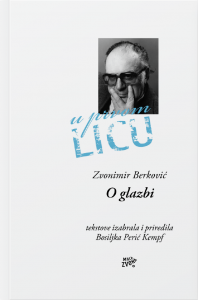
A collectionof music critiques and essays by Croatian film director and erudite Zvonimir Berković. Texts he wrote over several decades for newspapers and magazines are collected in this book and divided into four parts: Critique – Portraits – Meditations – Conversations. Collected and edited by Bosiljka Perić Kempf.

Zvonimir Berković wrote about music only occasionally, in the mid sixties and the first half of the seventies, for several newspapers and magazines. He left chronicles of the music lives of festival cities as Dubrovnik and Vienna, but he also wrote reviews of both local and foreign artists’ performances during the Zagreb concert season. Most interesting, however, are the author’s imagination and subtle (and not only musical) taste in the portraits of musicians, interpreters and composers. Music had a deep impact in Berković’s work of movie director, especially in his “Rondo”, a Croatian classic made in 1966.


Searching for Ivana

18,00 €

A biographical novel by Sanja Lovrenčić about the Croatian author Ivana Brlić Mažuranić. Written in the first-person singular, the story develops on two levels, in the past and in the present, unfolding around the changing and yet unchanging topics of family relations, artistic creation and female existence in the world of literature.

“K.Š.Gjalski” Award for the best Croatian novel in 2007.

Lili

10,00 €

Playing with the motives of Andersen’s “Little girl with the matches” Melita Kraus tells the story about a little she-dog named Lili, whose old master got ill and had to go to the hospital – on the Christmas Eve. The little dog is left alone and tries to win someone’s attention, but nobody cares for her. Very tired and hungry she rambles through the town, until she is too exhausted to continue. She lies down and sees – in a dream – her dog-parents. They give her advice – to knock at the door in front of which she is lying…

Simply told and emotional, ideal reading for the young children (+3).

Feminine Side of the Croatian Literature

14,00 €

Exploring the feminine side of Croatian literature Lidija Dujić offers a concise and interesting overview of selected segment of the Croatian literary history. She gives biographial sketches of Croatian female writers, explores the reception of their work and cliche images of women writers from the times of Renaissance to the contemporary age.  Analyzing and re-valuing some works, recognized under the label of “women’s literature”, the author challenges many commonplace notions – writing in first person singular. The book is based on her doctoral dissertation, but is intended for a wider audience.

Good Morning, World!

10,00 €

Diaries by the famous Croatian writer Ivana Brlić Mažuranić, written in the 1880s when she was fifteen to eighteen years old. The book provides insight into teenage life in the 19th century in Zagreb, the charming young character of the writer, her thoughts on literature, life and death, as well as the seeds of conflicts awaiting a female writer – all of which makes it a highly interesting read.

The Moon in December

At first glance, the Moon seems to be the central character of these “twelve stories for daydreaming”, but various other characters alternate under its shine and go through many unexpected experiences: under its light, snow owls hold their annual ball, it serves the little fairy as the highest jump in the sky, a mouse will use it as a model for a picture of the ideal cheese… When it disappears from the sky, four cats go in search of it, and when it reappears it will serve as a swing for three crazy dogs, winners in howling competition… (illustrated by Pika Vončina)

The Year Without a Rabbit

10,00 €

Leo is sitting in front of the house, lounging in a chair and thinking about the past year. The summer was great and promised a good start to seventh grade: with his brother and some friends he had founded a rock band that played a crazy summer hit, played in an international orchestra in Slovenia, and also, he had bathed in the sea. But when he returned to the city, things started going downhill – their pet, a brown rabbit, disappeared without trace, seventh grade started “badly”, with a pile of books, endless assignments and papers, and disagreement broke out with the new fencing coach … Sanja Lovrenčić enriched Croatian youth prose with a realistic and entertaining novel which, through the eyes of the smart, witty and talkative boy Leo, his family and friends, makes us aware (or reminds us) of the problems of growing up. Through the clarity of a child’s mind, we are faced with the absurdities of the adult world, as well as absurdities in schooling (very well described in the chapter “When you write about spring for the seventh time”). Adolescence has never been easy, but this novel shows that it can and should be fun!

(recommendation of the Vladimir Nazor Library in Zagreb)