• 0 Knjige - 0,00 €
    • Košarica je prazna.

Point Nemo

14,00 €

Mladen Kopjar is an author with extensive experience in writing different types of literary texts. In “Point Nemo”, his first collection of poetry, this experience is reflected in the ease and skill with which he builds his poetic world, as well as in his thoughtful and consistent poetics. The origins of the poems are usually in everyday life, its spaces, objects, small events, memories, but thanks to the gift of observation and skillful selection of details, the author skillfully avoids the superficiality and banality of “realistic” writing. Freedom and imagination lead him from concrete experience to surreal images in which personal associations are mixed with various fragments from the ubiquitous virtual space. But the unique tone of this collection stems from the deep emotionality with which the whole is imbued; the author addresses (or talks about) his loved ones: wife, child, parents, meandering through areas of tenderness and pain. In that intimate space, the outside world is mirrored in flashes; the original clash between an authentically, intensely internal world and a diverse, sometimes aggressive external world gives this poetry strength and interest.

Rascals in the Gutter

17,00 €

In the best tradition of young adult novels, but with a fresh voice, Josip Čekolj recounts the story of his rascals — four friends on the brink of adulthood. Although the town through which they roam is imaginary, their love and confusion, their conflicts and blunders, much like their need for warmth and belonging are all very real. As the rascals learn to find their way ‘in the gutter’, various characters show up to guide them along. Some are more trustworthy than others, and they largely come from the fringes of society, with perhaps the most important being an old lady with her cats and flair for poetry. And as usually happens in coming-of-age stories, their wading through murky waters becomes a first step towards maturity. The inspiration for this book was the exhibition ‘Rascals and Frogs’ by the visual artist Dominik Vuković, themed around memories of childhood. He illustrated this edition in close collaboration with the author, resulting in a special relationship between the text and illustrations.

Red Doves

19,00 €

The plot of this novel begins with the female narrator’s arrival on an unnamed Mediterranean island. She has inherited a house in an almost abandoned village and comes to see it; it is a good reason to get away from her daily struggles for a while. The landscape around her is nostalgically idyllic: crumbling stone houses, wild capers, homemade cheese, sunshine and wind. Everything suggests that there, at a distance from people, precarious jobs and urban routine, she’ll find a space for introspection, for facing her past, her desires and hopes. Along with the house, however, the narrator inherited a dovecot with a flock of pigeons bred by her deceased cousin, Toni. When she decides to release them from their prison, she has no idea that these homing birds will soon return to her along with six peculiar guests – Toni’s old friends. They organize a memorial party for him, and during three consecutive evenings they relate fragments of their shared past. Were they an international theater troupe that wandered the Mediterranean small towns in the seventies, or active participants in the political turmoil of the age of lead – it is difficult for the heroine to decide. At the end of the party, before they go away, the strange guests explain the true nature of her newly acquired inheritance: along with the house, she gets the obligation to tell their story, a story she did not fully grasp. And that’s where the Mediterranean idyll comes to an end: it will be replaced by a research into international terrorism in the 1970s, a personal revolt against the clash of wealth and poverty at that time and in the present, growing compassion for non-human living world and growing anger provoked by deadly business practices, cyber-subversions,  anger, fear and escape. To the fragments of her guests’ stories the heroine will react creating her own, a story that she will – when the storm she provoked subsides – almost unintentionally leave as a legacy to the new generation.

Safe Journey

14,00 €

Beatrice Masini and Gianni De Conno, the award-winning Italian tandem, communicate in this picture book the artistic and emotional experience of travelling. The combination of magnificent oneiric images and the poetic prose takes us on a journey into the unknown: sometimes the destination is known, and sometimes the trip is just aimless wandering; sometimes we encounter obstacles and surprises, sometimes “treasures we don’t know yet of.” Every journey is a unique experience; and the insights we gain, the feelings we go through, and the memories we create are its precious consequences. Attractive illustrations and suggestive short sentences stimulate imagination and their dreamy quality has won numerous readers; in 2018 Beatrice Masini and Gianni De Conno received the most prestigious prize in the field of children’s literature “SuperPremio Andersen”. For the great Gianni De Conno, this picture book marked the end of a life’s journey; it is the last and farewell gift he left us before his untimely death.


Book #3340

Saturn at the Winter Swimming Pool

20,00 €

The story begins one January morning when the planet Saturn suddenly materializes in the big swimming pool, at first in a smaller version of itself. The unexpected event shakes up the sleepy routine of the regular visitors of the swimming pool called ‘Future’. Lacking logical explanations, but brimming with their own ideas, they try to adapt to the new circumstances, hoping the planet will go away on its own. Some try to extract profit from the event, others pretend that nothing is happening, but finally it becomes clear to them all that they simply have to kick out the constantly growing Saturn out of their pool while it’s still possible! This picture-book, fully authored by Vendi Vernić, one of the foremost Croatian illustrators of the younger generation, will appeal to readers of all ages. The story can be read and interpreted on multiple levels: as an absurdist game of imagination, as a little study of a specific community, or as an allegory on melancholy and depression.

Searching for Ivana

18,00 €

A biographical novel by Sanja Lovrenčić about the Croatian author Ivana Brlić Mažuranić. Written in the first-person singular, the story develops on two levels, in the past and in the present, unfolding around the changing and yet unchanging topics of family relations, artistic creation and female existence in the world of literature.

“K.Š.Gjalski” Award for the best Croatian novel in 2007.

Serna and Mack in Pursuit of the Frightened Month

15,00 €

In his first prose text the young author uses patterns of traditional storytelling to speak about the contemporary problem of climate change. January disappeared, frightened by the absence of winter; a girl and a household spirit set off on a journey through the world of calendar, trying to find him and persuade him to come back. Adroitly following the spirit of the text, the illustrator uses elements from traditional book illustration, blending them with modern technique and expression.


Book #3348

Six Walks of Slava Raškaj

15,00 €

This picture-book is the first within a series with which Mala zvona introduces works of great Croatian visual artists to children. The famous Croatian impressionist painter S. Raškaj was deaf – and very sensitive to nature. Therefore, the writer of this picture book chose to represent her life and work in six walks with easel in different surroundings: the garden of her childhood, parks in the city where she learned to paint, winter woods and summer meadows where she made her best pictures. The illustrator did not copy the style of watercolors made by S. Raškaj, but gave the adequate transparence and lightness to his own.


Book #3338


Sketching out a Heroine

12,00 €

As a poet of proven skills, Sanja Lovrenčić sketches a mysterious heroine. Who is she? After reading, it is up to us to conclude. Or to let her continue to take shape within us for a long time. For, this collection of poems counts on the cooperation of a careful watcher and listener, a curious reader sensitive to language and its beyond. Sanja Lovrenčić invites us on an adventurous poetic journey through the poems/episodes of a very special, never fully expressible or sharply drawn protagonist, with whose joys, doubts, insights and resignations we easily empathise. (Dorta Jagić, ed.)

Longlisted for the Kamov Award 2021

Stories for the End of the World (and Other Everyday Trifles)

17,00 €

Don’t let the title fool you – in these witty micro-stories the end of the world is happening on an (almost) everyday level and “other trifles” may have an unexpected depth. Miniatures by Sanja Lovrenčić, organized in eight “chapters”, seemingly adapted to the short attention span of a modern reader, take into account things like morning-garbage-squads, polar bear wisdom, exodus of delivery people, time-stay-machines, mythical journeys and metaphorical animals. Sometimes entertaining, sometimes meditative, the author’s voice stays firm in defending the art of painting/playing with words and especially vocal against false/alternative literature that (allegedly) paints reality, media, and politics.  

The Cabinet for Sentimental Trivial Literature

12,00 €

Shortlisted for the Predrag Matvejević Award 2021, longlisted for the Fric Award 2019 Sanja Lovrenčić’s books draw into her net a reader who is ready for adventure, for whom reading is not merely following a linear plot and a pastime, but recognition and acceptance of a game that, when joined, becomes infinitely meaningful, subtle and even fun. Her new novel, entitled Cabinet for Sentimental Trivial Literature, in which is its set, but which is also an indicative determinant of what will be told, is certainly one of the “more readable” of her novels, i.e. one in which there are no traps for readers, unless they themselves want to fall into them. Also, as is often the case with this author, its structure is built somewhat conceptually, by changing the epistolary form, which makes up the main flow of narration, with inserted stories that form a rounded and meaningful whole it. There has been a crisis in the Cabinet, which is a kind of small, private and non-profit museum that houses the legacy of “sentimental and trivial literature”. The curator, who writes letters to the late founder Rosa, realizes that not only does the Cabinet need a “cash injection”, but also a new guardian to replace him. Since this is not just an ordinary job but also has a specific emotional and, of course, sentimental value, neither is easy to perform, and a job advertisement that includes one of the key sentences of the novel: “Your story is more important to us than your qualifications”, will further complicate matters. (…) Ten candidates apply to the ad that had inadvertently implied that candidates should also be writers, and they bring with them stories about their professional and private lives, sometimes completely bizarre, but also stories that make up an integral part of the novel. While the curator, who is becoming more and more desperate and sceptical, fills letters to Rosa with fragments from his own and the Cabinet’s everyday life, as well as those concerning the past, origin and meaning of her and his museum, an unusual and “soft” legacy that seems to have been run-over by a time of different imperatives  and priorities, the candidates succeed one another before him, with their experiences, but above all with the stories they enclose, enabling the novel to emerge from the closed space of the Cabinet into the outside, towards modernity and its peculiarities and problems. This “opening” – placed in stories within the story – subtly positions the novel towards recent reality, because it indirectly deals with the themes of art and artistic activism, social responsibility, commercialization and the entry of capital into unprofitable spheres of human activity, feminism. science and technology, but also love, which is one of the shared motives and concerns both interpersonal relationships and the preservation of some past values. (Jagna Pogačnik)

The Creepy House

16,00 €

The Creepy House is a skilful blend of a story about a family intending to move from the city to an old house surrounded by nature, an old-fashioned game of riddles, and fairy-tale elements that lend the whole book an air of fantasy that children find so irresistible. Solving the riddles given to them by the mysterious voice from the fireplace, Florijan and Klara explore the house and the garden, noticing so many things they did not see at first. With a bit of fear and lots of laughter, they experience a real adventure in search of a key they will use to ‘unlock’ the magic of their future home… The author shows a very good understanding of a child’s way of thinking and combines an imaginative plot with a subtle educational element about the world of plants and animals. The illustrator follows the story closely, complementing it with a number of small artistic surprises.

The Door I Do Not Know How to Open

17,00 €

There is a door that we don’t know how to open. Behind them lies the solution to the riddle, the beginning-and-end. This door leading to afterlife or to the void, are constantly present in some way in the ninth poetry book of the noted Croatian author Marija Lamot. But there are also numerous smaller doors that open wide in her poems – doors leading to memories, landscapes, mirrors, moments scattered in time, flashes of an intense present. They lead into the night, into bright light, into a classroom where philosophy is discussed, into family spaces and, above all, to trees and other beings that do not speak in human voices.

The Female World of the British Raj

17,00 €

Biljana Romić, born in 1960, is a Croatian indologist and cultural editor. She gained her Master of Arts title in 1997 in Zagreb, with a study of Bharati Mukherjee and postcolonial migrant faiths. She has ever since actively been researching and writing about postcolonialism and the notion of the Other. Her extensive study The women’s world of British India was written after she spent several years studying diaries and letters written by “memsahibs”. Her work is not simply a historical overview of their lives and roles during colonialism, it puts colonial history, literature and the notion of the “Other” in a contemporary critical context; Romić analyses over one hundred and fifty sources, including Indrani Sen, Amandeep Kaur, Kumari Jayawardena and Shashi Tharoor. When reading about the British colonial venture in India, we mostly encounter works that have been written from the male perspective of conquests and regimen – but colonial women have, almost from the very beginning, been a part of this venture. Biljana Romić’s book brings us the voices of these women and their lives. They journeyed into the unknown, often not prepared for the adversities of a different climate and the social roles they were going to find themselves in. They went into the unknown as wives, governesses, teachers, as young women in search of a husband; sometimes as entrepreneurs, missionaries, adventurers. Many stayed within the expected roles given by the British colonial community, but some of them showed that it is possible to overcome the limitations of their era, class and gender when it comes to their relation to India and Indians. Biljana Romić talks about the so-called “little history”, the one that appears on the margins of big historical events – and without which it is impossible to gain a complete picture of a time that has passed.

The Fly in the Atelier of Ivan Kožarić

15,00 €

How to introduce children to the world of a famous conceptual artist? The author of the text chose a character from the artist’s notebook, a little fly. Accidentally it enters the atelier – where all objects are wrapped in paper (the situation taken from real life). One by one they unwrap themselves for the little fly, telling and singing their stories. The illustrator creates the magical space of the atelier with highly original inventiveness, masterfully inserting citations of Kožarić’s works.


Book #3419

The Forgotten Girl

21,00 €

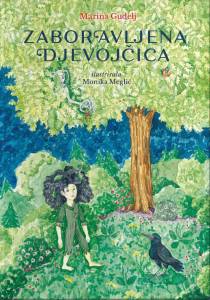
Moriko once lived in a castle. But once when, following her own heart, she broke the rules of her world, a merciless punishment came upon her: she was banished to oblivion. She no longer exists for people. No one can see her or remember her except as a fairy-tale figure. And if someone mentions her, even in passing, she is briefly turned into a fairy. The forest is her home, and a raven is her best friend. She understands trees, hears the feelings of grass and the little sounds in anthills. She sees what is invisible to people: desires and feelings, beings hidden behind the wind, rain, clouds. But the forest is not just a refuge – in its shadows lurk darkness, nightmares and other invisible things, and above them all the powerful and cruel Echo… This is a beautifully imaginative short novel for older children with just the right amount of darkness and a focus on perseverance and following one’s own emotional needs.