• 0 Knjige - 0,00 
    • Košarica je prazna.

The Female World of the British Raj

17,00  10,20 

Biljana Romić, born in 1960, is a Croatian indologist and cultural editor. She gained her Master of Arts title in 1997 in Zagreb, with a study of Bharati Mukherjee and postcolonial migrant faiths. She has ever since actively been researching and writing about postcolonialism and the notion of the Other. Her extensive study The women’s world of British India was written after she spent several years studying diaries and letters written by “memsahibs”. Her work is not simply a historical overview of their lives and roles during colonialism, it puts colonial history, literature and the notion of the “Other” in a contemporary critical context; Romić analyses over one hundred and fifty sources, including Indrani Sen, Amandeep Kaur, Kumari Jayawardena and Shashi Tharoor. When reading about the British colonial venture in India, we mostly encounter works that have been written from the male perspective of conquests and regimen – but colonial women have, almost from the very beginning, been a part of this venture. Biljana Romić’s book brings us the voices of these women and their lives. They journeyed into the unknown, often not prepared for the adversities of a different climate and the social roles they were going to find themselves in. They went into the unknown as wives, governesses, teachers, as young women in search of a husband; sometimes as entrepreneurs, missionaries, adventurers. Many stayed within the expected roles given by the British colonial community, but some of them showed that it is possible to overcome the limitations of their era, class and gender when it comes to their relation to India and Indians. Biljana Romić talks about the so-called “little history”, the one that appears on the margins of big historical events – and without which it is impossible to gain a complete picture of a time that has passed.

Rascals in the Gutter

17,00  10,20 

In the best tradition of young adult novels, but with a fresh voice, Josip Čekolj recounts the story of his rascals — four friends on the brink of adulthood. Although the town through which they roam is imaginary, their love and confusion, their conflicts and blunders, much like their need for warmth and belonging are all very real. As the rascals learn to find their way ‘in the gutter’, various characters show up to guide them along. Some are more trustworthy than others, and they largely come from the fringes of society, with perhaps the most important being an old lady with her cats and flair for poetry. And as usually happens in coming-of-age stories, their wading through murky waters becomes a first step towards maturity. The inspiration for this book was the exhibition ‘Rascals and Frogs’ by the visual artist Dominik Vuković, themed around memories of childhood. He illustrated this edition in close collaboration with the author, resulting in a special relationship between the text and illustrations.

Forgotten Things

17,00  10,20 

In her second artist’s book, Agata Lučić takes readers of all generations to a flea market – an almost monochromatic blue world filled with various objects. Each thing there carries traces of time spent in someone’s life, traces of somebody’s past. The young visual artist evokes fragments of life that “forgotten things” shared with their humans in her original, very recognizable style, gradually creating a warm atmosphere – with bits of magic. The last double-page holds a surprise: as the objects manage to attract new owners and are being accepted along with their stories, various colors enter the world of the picture book. It is no longer a space of memories; it becomes a living space. “Forgotten Things” are both nostalgic and cheerful, they urge the reader to open up to hidden histories of unknown people and certain values accessible only to a watchful eye; they invite both children and adults to dream, offering a world of peculiar visual pleasure. 

We acquire and discard things too easily, warns the author of this gentle and playful picture book; but even when they have already been discarded, left to their fate on the stands of some open-air “mini market”, they can be looked at, singled out from the crowd, appropriated, restored, and brought back to life.


Book #4909

Darkville

17,00  10,20 

Addressing the children for the first time, the renowned Darkville, the setting and the main character of this picture book written by a distinguished author Iva Bezinović-Haydon, is a sad town: all plants are being systematically cut there. No one really knows whose idea that was, but two city officials play a significant role in its implementation. One of them stamps the word ‘NO’ on all requests for a change, the other maintains order with his cutting tools – until a little blue flower emerges from a crack in the asphalt and everything starts to change… Using simple words and an appealing plot, the author talks about the need humans feel for the living green world, for colors, diversity and freedom, but also about different ways of standing up to bad rules imposed from somewhere above – it can be done in a hidden manner, in private spaces, or openly, in public, joining forces with other people. The young illustrator Laura Martinović brought the story about Darkville to life with her playful and warm illustrations, full of creative visual ideas and details that enrich the text.   

Stories for the End of the World (and Other Everyday Trifles)

17,00  10,20 

Don’t let the title fool you – in these witty micro-stories the end of the world is happening on an (almost) everyday level and “other trifles” may have an unexpected depth. Miniatures by Sanja Lovrenčić, organized in eight “chapters”, seemingly adapted to the short attention span of a modern reader, take into account things like morning-garbage-squads, polar bear wisdom, exodus of delivery people, time-stay-machines, mythical journeys and metaphorical animals. Sometimes entertaining, sometimes meditative, the author’s voice stays firm in defending the art of painting/playing with words and especially vocal against false/alternative literature that (allegedly) paints reality, media, and politics.  

Tintin and his Friends

17,00  10,20 

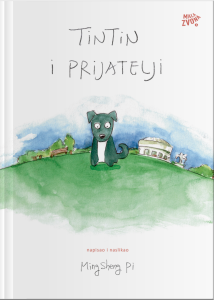
A basket for mushroom picking, a blanket, and a little black dog – that’s how this story begins. Even though he was abandoned in the forest, the little dog was lucky: he was adopted by two nice people. “Tintin and his Friends” is a diary of the first year they spent together, recorded mainly from the dog’s perspective. We see various little events, from their life at home to from their walks in the park, feeling the warmth the three of them share and following Tintin’s adventures with various dog-friends. In a multitude of small scenes Mingsheng Pi – a Chinese painter based in Zagreb and Tintin’s owner – tells, almost without words, a gentle and cheerful story about animals and people, showing an exceptional talent to spot details and, with just a few strokes of his brush, to evoke a space, an atmosphere, characters, and their relations. Readers of all ages will enjoy Tintin’s adventures, and the youngest among them will learn something new about dogs and their humans – like the importance a dog may have for a with hearing-impaired person.

Notes from Encountered Lands

17,00  10,20 

Miroslav Kirin’s book of travelogues brings together notes from different periods of the author’s life, but thanks to the coherence of his view and characteristic stylistic refinement, makes an organic whole. You could call it a kind of triptych: it starts with notes from Paris in 2005, the middle and most complex part is dedicated to the author’s sojourns in China, and the book ends with very short notes from various trips through Croatia. The author’s observations move in a wide range: from very simple everyday little things that catch his eye to the broad cultural issues of the Far East. Despite the variety of motives seen in the “encountered lands”, the traveler’s eye shows the same curiosity and the same clarity. The moments he records often turn into micro-stories, and out of the multitude of human outlines that appear in his notes and notebooks, some gain fullness and turn into impressive characters. Poetry runs through Kirin’s notes as a kind of weft – sometimes as initiator of travel, sometimes as an object of work and thought, sometimes as a latent awareness of the poetic values of language. Therefore, this book can give pleasure to both travel lovers and to all those who enjoy good literature.

Croatian Folktales

17,00  10,20 

After reading old Croatian folktales in a very serious book for adults,author Sanja Lovrenčić decided to set her favourite ones free and make them more accessible to children of today, telling them in her own literary voice, adjusting them slightly so that they would be more understandable. In eleven short tales, we meet a wide range of interesting heroes and antiheroes, from fox brides and tiny fairies to ravenous young women and mean bunnies. Set in magical and mystical forest settings skillfully depicted by Branka Hollingsworth, these tales – sometimes whimsy, sometimes not – now get to live on in the minds and hearts of new generations of young readers and listeners, saved from the terrible destiny of being forgotten.

Kosjenka and Regoč

17,00  10,20 

One of the most popular fairy tales penned by Ivana Brlić Mažuranić, and one of those that Croatian children first encounter, is precisely the one about Regoč. However, even though the original story is entitled simply “Regoč”, the little fairy Kosjenka plays a more important role in it. Curious and lively, she sets the sluggish giant on an adventure. Cheerful when she finds company, compassionate in times of trouble, she sacrifices all her fairy magic for new friends, for children from two feuding villages near the Zlovoda lake. Although the two main characters belong to the realm of the fantastical, the story ends on a perfectly human note, with the construction of a new village. And while Regoč returns to his town of Legen, Kosjenka can no longer go back among the fairies, so she stays with the children from the village – as well as with little readers. For this silent book, visual artist Vendi Vernić told Ivana Brlić Mažuranić’s story in a purely visual language. For those who do not know the original, there is a small glossary at the beginning. Converted into pictures, the story becomes accessible to preschool readers.

The Little Key

17,00  10,20 

Starting from a banal event – a shoe that was untied and a key found on the street – the little heroine of this picture book talks about her loved ones. For each of them, such a key could serve something, unlock something of theirs: mom’s glass showcase, dad’s mysterious drawer, a compartment with love letters in grandma’s cabinet, a friend’s special pencil case, her brother’s box with figurines of dragons and knights. With each contemplation of the key, an image from everyday life is “unlocked”. But in the end, the girl concludes that the key will best serve her and her own imagination.
The author of this story about curiosity is the acclaimed and experienced writer Sanja Lovrenčić, and the book was illustrated by Lucija Mrzljak, an award-winning artist educated in Zagreb, Prague, Krakow and Tallinn.

A Reflection in the Rain

17,00  10,20 

Jasmina Kosanović, the author of a series of interesting and well-received picture books, does not seem to know how to tell a story about rain. Instead of words, images come to her, all airy and gentle – truly rainy. But for those who like to give themselves over to their imagination, every illustration in this picture book can be the beginning of an adventure. What are those people waiting for under their umbrellas? Who does a sad man with a scarf break up with? Who is behind the windows where the drops are pouring down? Where is the sailboat sailing under an almost clear, yet still rain-soaked sky? A series of rainy scenes results in the author seeing her own self clearly, sun kissed. Those who imagine a series of their own rainy stories will perhaps find out something about themselves, once they eventually emerge from Jasmina’s dreamy, watercolour world.

Chet Baker on the Beach

17,00 

In the new poetry book by the acclaimed and award-winning Croatian poet Ivan Babić, “Chet Baker on the Beach”, the readers will notice, on the one hand, the maturity, clarity of concept and stylistic certainty of this experienced writer, and on the other hand his talent for a short form that unites the lyrical and the meditative, and within which the author manages to transform elements of sensory, organic reality into imaginative metaphor. The dominant thematic framework of these subtle poems is love. The foreboding of opening up to another person, the fragility of closeness, unrest, hope and absence alternate like musical variations in a book that is, as the title already testifies, inspired and imbued with music. Music is, however, most present in the poems of the central, titular cycle, where it appears in a multiple role – as an incentive for language, as a possibility of dialogue across the barriers that separate different artistic disciplines, as an embodiment of psychological states and moods. Breath and respiration run through the manuscript as an organic link between music and song, but also as the presence of the living world of nature for which the author shows a special sensitivity (noted in his previous collections). Babić’s sense of language is manifested in lexical abundance, a flexible sentence that manages to remain light despite its complexity, an imaginative but unobtrusive creation of neologisms, and the ability to create a small, concise and rounded whole with well-chosen words.

The Door I Do Not Know How to Open

17,00 

There is a door that we don’t know how to open. Behind them lies the solution to the riddle, the beginning-and-end. This door leading to afterlife or to the void, are constantly present in some way in the ninth poetry book of the noted Croatian author Marija Lamot. But there are also numerous smaller doors that open wide in her poems – doors leading to memories, landscapes, mirrors, moments scattered in time, flashes of an intense present. They lead into the night, into bright light, into a classroom where philosophy is discussed, into family spaces and, above all, to trees and other beings that do not speak in human voices.

Searching for Ivana

18,00  10,80 

A biographical novel by Sanja Lovrenčić about the Croatian author Ivana Brlić Mažuranić. Written in the first-person singular, the story develops on two levels, in the past and in the present, unfolding around the changing and yet unchanging topics of family relations, artistic creation and female existence in the world of literature.

“K.Š.Gjalski” Award for the best Croatian novel in 2007.

Meandering with Julije Knifer

18,00  10,80 

“Whenever I find something that I like, I want to tell a story about it” , says the narrator of this book. But she will by no means tell the story of Julije Knifer and his famous meander motif alone. The painter himself talks about anti-paintings and anti-bulbs, about the rhythms of black and white, vertical and horizontal lines, research and the search for extremes – all of this in his own words taken from original diary entries. And the illustrations inspired by his art also tell the readers about his journey towards and with meanders in their own way. In the fifth picture book of their Croatian fine art series, Sanja Lovrenčić and Dominik Vuković present the work of one of the most original and respected Croatian artists of the twentieth century, well-recognized abroad.

Art is Smart

18,00  10,80 

At the heart of the new picture book by the award-winning illustrator Agata Lučić is art itself, in all its joyful forms. On the pages of this book, intended for children, but which will delight and cheer up adults as well, we will hear numerous and varied answers to the questions of what art can do, where it can be found, how we can most easily encounter it. ‘Art is Smart’ is a praise of art itself, but also a short lesson for the young ones about different kinds of artistic activity and their equal importance. The picture book is abundantly and dynamically illustrated in the author’s recognizable style, and the text flows in an unstilted poetic style, with cheerful rhymes that arouse curiosity in the reader and draw her on to an optimistic close.