• 0 Knjige - 0,00 
    • Košarica je prazna.

Serna and Mack in Pursuit of the Frightened Month

15,00  9,00 

In his first prose text the young author uses patterns of traditional storytelling to speak about the contemporary problem of climate change. January disappeared, frightened by the absence of winter; a girl and a household spirit set off on a journey through the world of calendar, trying to find him and persuade him to come back. Adroitly following the spirit of the text, the illustrator uses elements from traditional book illustration, blending them with modern technique and expression.


Book #3348

A Happy Day in Our Neighbourhood

18,00 

The new picture book by Sanja Lovrenčić and Dominik Vuković follows the journey of a single rose. Passing from hand to hand, the red flower outlines the life of a city neighbourhood through which it is carried by various characters. The neighbourhood is a rich microworld in which chance encounters, small daily rituals and never-ending human dramas take place. The characters that the rose travels among belong to different social groups: from dog walkers, young parents, a shop assistant, a resident of a nursing home and a young artist, to marginalized people such as an elderly homeless man and a street musician. All of them, however, are connected by a simple gesture of kindness: passing the rose from one hand to another. The rose thus becomes a metaphor for the community that permeates the fabric of the city, despite the ever-present differences. Ultimately, this tender flower symbolizes the fragility of every gentle gesture – but also its beauty.

Goat-Foot

15,00 

This story about a fairy is inspired by real-life experience. Its author Mirjana Mrkela speaks about loneliness and feelings of rejection, common in the lives of people who seem different from the majority. As a person who lost her sight in adulthood, the author easily sympathizes with people who are rejected or marginalized in our society for whatever reason. She tells her story as a fairy tale, drawing on certain elements from Slavic mythology. Her heroine, a fairy who, having stepped into the realm of some kind of evil old magic, becomes a goat, retreats from people who do not accept her. She hides in a mountain world of plants and animals and grieves there. But the moon and the sun are there for her, as well as for all other beings. The moon encourages her with its shine, and the sun makes her strong and calm. The pale fairy represents all those who long for understanding and acceptance. The author created the picture book in close collaboration with Katarina Radošević Galić, a Croatian illustrator and scenographer.

The Door I Do Not Know How to Open

17,00 

There is a door that we don’t know how to open. Behind them lies the solution to the riddle, the beginning-and-end. This door leading to afterlife or to the void, are constantly present in some way in the ninth poetry book of the noted Croatian author Marija Lamot. But there are also numerous smaller doors that open wide in her poems – doors leading to memories, landscapes, mirrors, moments scattered in time, flashes of an intense present. They lead into the night, into bright light, into a classroom where philosophy is discussed, into family spaces and, above all, to trees and other beings that do not speak in human voices.

Point Nemo

14,00  8,40 

Mladen Kopjar is an author with extensive experience in writing different types of literary texts. In “Point Nemo”, his first collection of poetry, this experience is reflected in the ease and skill with which he builds his poetic world, as well as in his thoughtful and consistent poetics. The origins of the poems are usually in everyday life, its spaces, objects, small events, memories, but thanks to the gift of observation and skillful selection of details, the author skillfully avoids the superficiality and banality of “realistic” writing. Freedom and imagination lead him from concrete experience to surreal images in which personal associations are mixed with various fragments from the ubiquitous virtual space. But the unique tone of this collection stems from the deep emotionality with which the whole is imbued; the author addresses (or talks about) his loved ones: wife, child, parents, meandering through areas of tenderness and pain. In that intimate space, the outside world is mirrored in flashes; the original clash between an authentically, intensely internal world and a diverse, sometimes aggressive external world gives this poetry strength and interest.

The Creepy House

16,00  9,60 

The Creepy House is a skilful blend of a story about a family intending to move from the city to an old house surrounded by nature, an old-fashioned game of riddles, and fairy-tale elements that lend the whole book an air of fantasy that children find so irresistible. Solving the riddles given to them by the mysterious voice from the fireplace, Florijan and Klara explore the house and the garden, noticing so many things they did not see at first. With a bit of fear and lots of laughter, they experience a real adventure in search of a key they will use to ‘unlock’ the magic of their future home… The author shows a very good understanding of a child’s way of thinking and combines an imaginative plot with a subtle educational element about the world of plants and animals. The illustrator follows the story closely, complementing it with a number of small artistic surprises.

Monsters

15,00  9,00 

Lili loves colours. Everything around her is always colourful. Her room, her drawings, her clothes, her thoughts. Until one Monday, when Lili loses in a race and nothing can help her feel better. One by one, monsters come and steal colours out of her life, leaving her in a sombre world as she deals with disappointment and sadness. But Lili will find out that, even though it does not always seem so, colours have a way of finding their way back into our lives – with a little help from our friends. An important story told in a simple yet effective way, with gorgeous illustrations by award-winning artist Klasja Habjan.

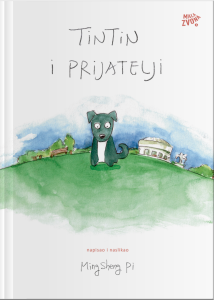
Tintin and his Friends

17,00  10,20 

A basket for mushroom picking, a blanket, and a little black dog – that’s how this story begins. Even though he was abandoned in the forest, the little dog was lucky: he was adopted by two nice people. “Tintin and his Friends” is a diary of the first year they spent together, recorded mainly from the dog’s perspective. We see various little events, from their life at home to from their walks in the park, feeling the warmth the three of them share and following Tintin’s adventures with various dog-friends. In a multitude of small scenes Mingsheng Pi – a Chinese painter based in Zagreb and Tintin’s owner – tells, almost without words, a gentle and cheerful story about animals and people, showing an exceptional talent to spot details and, with just a few strokes of his brush, to evoke a space, an atmosphere, characters, and their relations. Readers of all ages will enjoy Tintin’s adventures, and the youngest among them will learn something new about dogs and their humans – like the importance a dog may have for a with hearing-impaired person.

Dormitory

14,00  8,40 

Although it could seem that the primary origin of this poetry is the world of words – the author recurrently affirms the experience of reading as something very much alive and inspiring – the contact with her own material environment is equally important for Lidija Dujić. And no matter how linguistically complex, surprising, metaphorical this poetry is, and how far it takes (ironic) distance from reality, it always remains tied to the real moment that triggered poetic imagination and caused poetic language to flow. Singling out some moments, turning flashes of reality into a thoughtful linguistic structure, the poet creates original and meditative images, with a clear awareness of poetry as non-ordinary speech.

Darkville

17,00  10,20 

Addressing the children for the first time, the renowned Darkville, the setting and the main character of this picture book written by a distinguished author Iva Bezinović-Haydon, is a sad town: all plants are being systematically cut there. No one really knows whose idea that was, but two city officials play a significant role in its implementation. One of them stamps the word ‘NO’ on all requests for a change, the other maintains order with his cutting tools – until a little blue flower emerges from a crack in the asphalt and everything starts to change… Using simple words and an appealing plot, the author talks about the need humans feel for the living green world, for colors, diversity and freedom, but also about different ways of standing up to bad rules imposed from somewhere above – it can be done in a hidden manner, in private spaces, or openly, in public, joining forces with other people. The young illustrator Laura Martinović brought the story about Darkville to life with her playful and warm illustrations, full of creative visual ideas and details that enrich the text.   

Red Doves

19,00  11,40 

The plot of this novel begins with the female narrator’s arrival on an unnamed Mediterranean island. She has inherited a house in an almost abandoned village and comes to see it; it is a good reason to get away from her daily struggles for a while. The landscape around her is nostalgically idyllic: crumbling stone houses, wild capers, homemade cheese, sunshine and wind. Everything suggests that there, at a distance from people, precarious jobs and urban routine, she’ll find a space for introspection, for facing her past, her desires and hopes. Along with the house, however, the narrator inherited a dovecot with a flock of pigeons bred by her deceased cousin, Toni. When she decides to release them from their prison, she has no idea that these homing birds will soon return to her along with six peculiar guests – Toni’s old friends. They organize a memorial party for him, and during three consecutive evenings they relate fragments of their shared past. Were they an international theater troupe that wandered the Mediterranean small towns in the seventies, or active participants in the political turmoil of the age of lead – it is difficult for the heroine to decide. At the end of the party, before they go away, the strange guests explain the true nature of her newly acquired inheritance: along with the house, she gets the obligation to tell their story, a story she did not fully grasp. And that’s where the Mediterranean idyll comes to an end: it will be replaced by a research into international terrorism in the 1970s, a personal revolt against the clash of wealth and poverty at that time and in the present, growing compassion for non-human living world and growing anger provoked by deadly business practices, cyber-subversions,  anger, fear and escape. To the fragments of her guests’ stories the heroine will react creating her own, a story that she will – when the storm she provoked subsides – almost unintentionally leave as a legacy to the new generation.

The Moon in December

At first glance, the Moon seems to be the central character of these “twelve stories for daydreaming”, but various other characters alternate under its shine and go through many unexpected experiences: under its light, snow owls hold their annual ball, it serves the little fairy as the highest jump in the sky, a mouse will use it as a model for a picture of the ideal cheese… When it disappears from the sky, four cats go in search of it, and when it reappears it will serve as a swing for three crazy dogs, winners in howling competition… (illustrated by Pika Vončina)

The Year Without a Rabbit

10,00  6,00 

Leo is sitting in front of the house, lounging in a chair and thinking about the past year. The summer was great and promised a good start to seventh grade: with his brother and some friends he had founded a rock band that played a crazy summer hit, played in an international orchestra in Slovenia, and also, he had bathed in the sea. But when he returned to the city, things started going downhill – their pet, a brown rabbit, disappeared without trace, seventh grade started “badly”, with a pile of books, endless assignments and papers, and disagreement broke out with the new fencing coach … Sanja Lovrenčić enriched Croatian youth prose with a realistic and entertaining novel which, through the eyes of the smart, witty and talkative boy Leo, his family and friends, makes us aware (or reminds us) of the problems of growing up. Through the clarity of a child’s mind, we are faced with the absurdities of the adult world, as well as absurdities in schooling (very well described in the chapter “When you write about spring for the seventh time”). Adolescence has never been easy, but this novel shows that it can and should be fun!

(recommendation of the Vladimir Nazor Library in Zagreb)

Deceptions and Spectres

16,00  9,60 
Book #3399

The Sneering Bird

16,00  9,60 

Illustrating a fable about a parrot run away from the ZOO who meets various animals and finds all of them for some reason ridiculous until a fox teaches it a lesson, the artist Ivana Pipal finds ingenious ways of representing basically the same situation: the parrot and another animal. Giving each protagonist mood and personality, and creating at the same time deeply pleasant green world of the woods, she turns the tale about understanding and accepting others into rich visual pleasure.


Book #3396


Travertine Bridge

11,00  6,60 

In “Travertine Bridge”, the author Jana Prević Finderle, based on her own experience and memories, introduces us to the life of travelers and the world of travel. The short travel sketches act like original postcards addressed to the reader; a concise description derived from the author’s impression of a place, fellow traveler, or guest turns into a vivid picture before our eyes. From a modest summer vacation on the Adriatic Sea in early childhood, to somewhat later family car trips to Paris and London, to independent wanderings around the world in adulthood, the author’s text, sometimes humorous, sometimes melancholic, and almost always nostalgic, seems somehow familiar to us and encourages us to embark on an adventure ourselves. The text is accompanied by drawings by Mate Rupić, who skillfully and thoughtfully transferred some of the vivid moments of Jana’s stories to paper using the ink technique.