• 0 Knjige - 0,00 
    • Košarica je prazna.

Forgotten Things

17,00  10,20 

In her second artist’s book, Agata Lučić takes readers of all generations to a flea market – an almost monochromatic blue world filled with various objects. Each thing there carries traces of time spent in someone’s life, traces of somebody’s past. The young visual artist evokes fragments of life that “forgotten things” shared with their humans in her original, very recognizable style, gradually creating a warm atmosphere – with bits of magic. The last double-page holds a surprise: as the objects manage to attract new owners and are being accepted along with their stories, various colors enter the world of the picture book. It is no longer a space of memories; it becomes a living space. “Forgotten Things” are both nostalgic and cheerful, they urge the reader to open up to hidden histories of unknown people and certain values accessible only to a watchful eye; they invite both children and adults to dream, offering a world of peculiar visual pleasure. 

We acquire and discard things too easily, warns the author of this gentle and playful picture book; but even when they have already been discarded, left to their fate on the stands of some open-air “mini market”, they can be looked at, singled out from the crowd, appropriated, restored, and brought back to life.


Book #4909

Red Doves

19,00  11,40 

The plot of this novel begins with the female narrator’s arrival on an unnamed Mediterranean island. She has inherited a house in an almost abandoned village and comes to see it; it is a good reason to get away from her daily struggles for a while. The landscape around her is nostalgically idyllic: crumbling stone houses, wild capers, homemade cheese, sunshine and wind. Everything suggests that there, at a distance from people, precarious jobs and urban routine, she’ll find a space for introspection, for facing her past, her desires and hopes. Along with the house, however, the narrator inherited a dovecot with a flock of pigeons bred by her deceased cousin, Toni. When she decides to release them from their prison, she has no idea that these homing birds will soon return to her along with six peculiar guests – Toni’s old friends. They organize a memorial party for him, and during three consecutive evenings they relate fragments of their shared past. Were they an international theater troupe that wandered the Mediterranean small towns in the seventies, or active participants in the political turmoil of the age of lead – it is difficult for the heroine to decide. At the end of the party, before they go away, the strange guests explain the true nature of her newly acquired inheritance: along with the house, she gets the obligation to tell their story, a story she did not fully grasp. And that’s where the Mediterranean idyll comes to an end: it will be replaced by a research into international terrorism in the 1970s, a personal revolt against the clash of wealth and poverty at that time and in the present, growing compassion for non-human living world and growing anger provoked by deadly business practices, cyber-subversions,  anger, fear and escape. To the fragments of her guests’ stories the heroine will react creating her own, a story that she will – when the storm she provoked subsides – almost unintentionally leave as a legacy to the new generation.

Rascals in the Gutter

17,00  10,20 

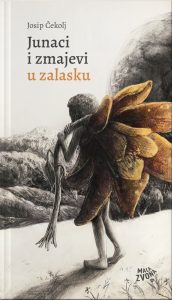
In the best tradition of young adult novels, but with a fresh voice, Josip Čekolj recounts the story of his rascals — four friends on the brink of adulthood. Although the town through which they roam is imaginary, their love and confusion, their conflicts and blunders, much like their need for warmth and belonging are all very real. As the rascals learn to find their way ‘in the gutter’, various characters show up to guide them along. Some are more trustworthy than others, and they largely come from the fringes of society, with perhaps the most important being an old lady with her cats and flair for poetry. And as usually happens in coming-of-age stories, their wading through murky waters becomes a first step towards maturity. The inspiration for this book was the exhibition ‘Rascals and Frogs’ by the visual artist Dominik Vuković, themed around memories of childhood. He illustrated this edition in close collaboration with the author, resulting in a special relationship between the text and illustrations.

Letters for Everyone

15,00  9,00 

This playful and cheerful book is perfect for those learning to read as well as for those who are helping them in this endeavor. Every of thirty very short stories – in which numerous characters, both human and animal, appear – is dominated by one single letter. This letter can be searched for, with ears or eyes, and every story can be continued. This unique spelling book invites the reader to play whereby it turns gaining reading habits into an easy and fun project.

All My Loved Ones But Me

13,00  7,80 

Luka Mavretić’s third poetry collection “All My Loved Ones But Me” is a series of “inner journeys” – journeys that the author announces in the first poems of this very thoughtfully built piece. The young poet balances between lyrical verses and prosaic sentences, he strives towards a refined simplicity and manages to create a conversational tone, which is an important building block of his poetical world. An abundance of motives and a diary-like directness make this book an interesting and fresh collection. Even though he uses interpunction which creates finished, harmonical sentences and gives the text a prosaic tone, his verses remain verses, lines with a natural and easy flow. Despite a breezy atmosphere that the author creates, this is a collection of well thought-through and refined texts – Luka Mavretić is a poet who, in an alchemy of words, transforms chosen glimpses of reality into memorable and luminous images.

Heroes and Dragons on the Decline

13,00  7,80 

Imagination and a certain freedom in his relation to language as well as an authentic poetical experience characterize Josip Čekolj’s first poetry collection. In four parts – four zeals – the lyrical voice of this young and talented author celebrates the novelty of his first worlds, from the home region, both in a concrete and a symbolic form, to the world of family and first loves. The magic of these poems mostly arises from the peculiar shifts from real to surreal, from bright images that depict an underlying emotion. The author builds his space of words, a space that is built from moments he has experienced. This space is often related to motives that originate in nature and in traditional culture, but it is consistently original, full of surprises and freshness.

The Female World of the British Raj

17,00  10,20 

Biljana Romić, born in 1960, is a Croatian indologist and cultural editor. She gained her Master of Arts title in 1997 in Zagreb, with a study of Bharati Mukherjee and postcolonial migrant faiths. She has ever since actively been researching and writing about postcolonialism and the notion of the Other. Her extensive study The women’s world of British India was written after she spent several years studying diaries and letters written by “memsahibs”. Her work is not simply a historical overview of their lives and roles during colonialism, it puts colonial history, literature and the notion of the “Other” in a contemporary critical context; Romić analyses over one hundred and fifty sources, including Indrani Sen, Amandeep Kaur, Kumari Jayawardena and Shashi Tharoor. When reading about the British colonial venture in India, we mostly encounter works that have been written from the male perspective of conquests and regimen – but colonial women have, almost from the very beginning, been a part of this venture. Biljana Romić’s book brings us the voices of these women and their lives. They journeyed into the unknown, often not prepared for the adversities of a different climate and the social roles they were going to find themselves in. They went into the unknown as wives, governesses, teachers, as young women in search of a husband; sometimes as entrepreneurs, missionaries, adventurers. Many stayed within the expected roles given by the British colonial community, but some of them showed that it is possible to overcome the limitations of their era, class and gender when it comes to their relation to India and Indians. Biljana Romić talks about the so-called “little history”, the one that appears on the margins of big historical events – and without which it is impossible to gain a complete picture of a time that has passed.

Sketching out a Heroine

12,00  7,20 

As a poet of proven skills, Sanja Lovrenčić sketches a mysterious heroine. Who is she? After reading, it is up to us to conclude. Or to let her continue to take shape within us for a long time. For, this collection of poems counts on the cooperation of a careful watcher and listener, a curious reader sensitive to language and its beyond. Sanja Lovrenčić invites us on an adventurous poetic journey through the poems/episodes of a very special, never fully expressible or sharply drawn protagonist, with whose joys, doubts, insights and resignations we easily empathise. (Dorta Jagić, ed.)

Longlisted for the Kamov Award 2021

Piccola con piccolo

13,00  7,80 

The little girl Piccola shows an unusual feeling for sounds. Imitating the chirping of birds, the crackling of fire, the sounds of the wind and everything else that surrounds her, Piccola amazes the listeners singing her little melodies. When she comes to a
music school and old Professore starts teaching her to play the piccolo, the smallest girl with the smallest flute becomes ‘Piccola con piccolo’; her Bird Music becomes a huge success and she is invited to perform all over the world. Piccola con piccolo
is the first picture book written by Bruno Mezić. Creating a likable character of the little girl Piccola,
telling about her adventures in sound, and skillfully playing with Italian words, the author introduces young readers to the terminology of classical music. Illustrations by the young visual artist and designer Klasja Habjan imaginatively and playfully follow the text and bring to life the original little heroine and her music.


Book #3705


Deceptions and Spectres

16,00  9,60 
Book #3399

The Sneering Bird

16,00  9,60 

Illustrating a fable about a parrot run away from the ZOO who meets various animals and finds all of them for some reason ridiculous until a fox teaches it a lesson, the artist Ivana Pipal finds ingenious ways of representing basically the same situation: the parrot and another animal. Giving each protagonist mood and personality, and creating at the same time deeply pleasant green world of the woods, she turns the tale about understanding and accepting others into rich visual pleasure.


Book #3396


Travertine Bridge

11,00  6,60 

In “Travertine Bridge”, the author Jana Prević Finderle, based on her own experience and memories, introduces us to the life of travelers and the world of travel. The short travel sketches act like original postcards addressed to the reader; a concise description derived from the author’s impression of a place, fellow traveler, or guest turns into a vivid picture before our eyes. From a modest summer vacation on the Adriatic Sea in early childhood, to somewhat later family car trips to Paris and London, to independent wanderings around the world in adulthood, the author’s text, sometimes humorous, sometimes melancholic, and almost always nostalgic, seems somehow familiar to us and encourages us to embark on an adventure ourselves. The text is accompanied by drawings by Mate Rupić, who skillfully and thoughtfully transferred some of the vivid moments of Jana’s stories to paper using the ink technique.

A Short Trip Home and other Stories

14,00  8,40 
Book #3328


Serna and Mack in Pursuit of the Frightened Month

15,00  9,00 

In his first prose text the young author uses patterns of traditional storytelling to speak about the contemporary problem of climate change. January disappeared, frightened by the absence of winter; a girl and a household spirit set off on a journey through the world of calendar, trying to find him and persuade him to come back. Adroitly following the spirit of the text, the illustrator uses elements from traditional book illustration, blending them with modern technique and expression.


Book #3348

The Fly in the Atelier of Ivan Kožarić

15,00  9,00 

How to introduce children to the world of a famous conceptual artist? The author of the text chose a character from the artist’s notebook, a little fly. Accidentally it enters the atelier – where all objects are wrapped in paper (the situation taken from real life). One by one they unwrap themselves for the little fly, telling and singing their stories. The illustrator creates the magical space of the atelier with highly original inventiveness, masterfully inserting citations of Kožarić’s works.


Book #3419

Safe Journey

14,00  8,40 

Beatrice Masini and Gianni De Conno, the award-winning Italian tandem, communicate in this picture book the artistic and emotional experience of travelling. The combination of magnificent oneiric images and the poetic prose takes us on a journey into the unknown: sometimes the destination is known, and sometimes the trip is just aimless wandering; sometimes we encounter obstacles and surprises, sometimes “treasures we don’t know yet of.” Every journey is a unique experience; and the insights we gain, the feelings we go through, and the memories we create are its precious consequences. Attractive illustrations and suggestive short sentences stimulate imagination and their dreamy quality has won numerous readers; in 2018 Beatrice Masini and Gianni De Conno received the most prestigious prize in the field of children’s literature “SuperPremio Andersen”. For the great Gianni De Conno, this picture book marked the end of a life’s journey; it is the last and farewell gift he left us before his untimely death.


Book #3340