• 0 Knjige - 0,00 
    • Košarica je prazna.

Children

Monsters

15,00 

Lili loves colours. Everything around her is always colourful. Her room, her drawings, her clothes, her thoughts. Until one Monday, when Lili loses in a race and nothing can help her feel better. One by one, monsters come and steal colours out of her life, leaving her in a sombre world as she deals with disappointment and sadness. But Lili will find out that, even though it does not always seem so, colours have a way of finding their way back into our lives – with a little help from our friends. An important story told in a simple yet effective way, with gorgeous illustrations by award-winning artist Klasja Habjan.

Why Bach Said Ah

15,00 

Vesna Matana Matić, an experienced musician with pedagogical experience, in her playful fantasy on the subject of classical music and modern technology, conjures up the great composer surrounded by his numerous children. Children’s cries, laughter and insistent questions are the lively background against which Johann Sebastian’s works are created – until the moment when the composer calls for help from the future, so that he can work in peace. Help does indeed arrive, in the form of a little girl, Selfiene, who gives Bach’s children smartphones. A silence ensues in which no one even notices the house cat any more. But this silence is not in the least stimulating: the melodies in the composer’s head have also fallen silent… This picture book is designed so that the youngest readers can learn something about classical music in a fun way, but also to reflect on the changes that electronic devices have brought to family life. The text is accompanied by imaginative illustrations by the young artist Doria Jantolić.

Goat-Foot

15,00 

This story about a fairy is inspired by real-life experience. Its author Mirjana Mrkela speaks about loneliness and feelings of rejection, common in the lives of people who seem different from the majority. As a person who lost her sight in adulthood, the author easily sympathizes with people who are rejected or marginalized in our society for whatever reason. She tells her story as a fairy tale, drawing on certain elements from Slavic mythology. Her heroine, a fairy who, having stepped into the realm of some kind of evil old magic, becomes a goat, retreats from people who do not accept her. She hides in a mountain world of plants and animals and grieves there. But the moon and the sun are there for her, as well as for all other beings. The moon encourages her with its shine, and the sun makes her strong and calm. The pale fairy represents all those who long for understanding and acceptance. The author created the picture book in close collaboration with Katarina Radošević Galić, a Croatian illustrator and scenographer.

The Sneering Bird

16,00 

Illustrating a fable about a parrot run away from the ZOO who meets various animals and finds all of them for some reason ridiculous until a fox teaches it a lesson, the artist Ivana Pipal finds ingenious ways of representing basically the same situation: the parrot and another animal. Giving each protagonist mood and personality, and creating at the same time deeply pleasant green world of the woods, she turns the tale about understanding and accepting others into rich visual pleasure.


Book #3396


Ema is Alone

16,00 

The story about Ema – written by Vanja Marković, an expert in inclusive and social pedagogy – deals with an important topic of our time: the way people perceive each other. Roaming the streets of her hometown, the little heroine is trying to find someone to play with. She encounters a whole bunch of various characters, but they notice only her looks – her shaggy hair, her huge eyes, her dirty jacket. They all nag her and none of them wants to follow her imagination, but her ideas for games remain on pages, as possibilities for readers themselves to develop. In the end even Ema repeats the pattern that surrounds her: when a yellow cat asks her to play with it she refuses the invitation, thinking that a black cat would be much more interesting. In a playful way the story opens the readers’ eyes to the wrongs implied in superficial ways of looking at others. The storyteller’s style is simple and flowing, very well adapted to the target group of readers (6-8). The illustrations by Vibor Juhas complement and enrich the text; they are close to the aesthetics of comic books and full of little visual surprises.

The Creepy House

16,00 

The Creepy House is a skilful blend of a story about a family intending to move from the city to an old house surrounded by nature, an old-fashioned game of riddles, and fairy-tale elements that lend the whole book an air of fantasy that children find so irresistible. Solving the riddles given to them by the mysterious voice from the fireplace, Florijan and Klara explore the house and the garden, noticing so many things they did not see at first. With a bit of fear and lots of laughter, they experience a real adventure in search of a key they will use to ‘unlock’ the magic of their future home… The author shows a very good understanding of a child’s way of thinking and combines an imaginative plot with a subtle educational element about the world of plants and animals. The illustrator follows the story closely, complementing it with a number of small artistic surprises.

Windwalk

16,00 

At first glance, this unusual picture book seems to be entirely dedicated to the endless diversity of winds. But in fact, it questions the ways in which people experience and describe the world. The main character of the story, Tanja the Windwalker, initially performs her job in accordance with the rules and expectations of the wind observation service. However, over time, this passionate wind lover is no longer satisfied with the ordinary language of official reports; she begins to write differently – more personally and poetically, and it takes her more time to formulate sentences. At the same time, various wind officials find it increasingly difficult to understand her… The author of the text, Igor Rajki, conjures up Tanja’s experiences in the worlds of wind and language with strange new coinages and quirky puns, while the illustrator Klasja Habjan creates an imaginative visual world in harmony with the story.

Rascals in the Gutter

17,00 

In the best tradition of young adult novels, but with a fresh voice, Josip Čekolj recounts the story of his rascals — four friends on the brink of adulthood. Although the town through which they roam is imaginary, their love and confusion, their conflicts and blunders, much like their need for warmth and belonging are all very real. As the rascals learn to find their way ‘in the gutter’, various characters show up to guide them along. Some are more trustworthy than others, and they largely come from the fringes of society, with perhaps the most important being an old lady with her cats and flair for poetry. And as usually happens in coming-of-age stories, their wading through murky waters becomes a first step towards maturity. The inspiration for this book was the exhibition ‘Rascals and Frogs’ by the visual artist Dominik Vuković, themed around memories of childhood. He illustrated this edition in close collaboration with the author, resulting in a special relationship between the text and illustrations.

Forgotten Things

17,00 

In her second artist’s book, Agata Lučić takes readers of all generations to a flea market – an almost monochromatic blue world filled with various objects. Each thing there carries traces of time spent in someone’s life, traces of somebody’s past. The young visual artist evokes fragments of life that “forgotten things” shared with their humans in her original, very recognizable style, gradually creating a warm atmosphere – with bits of magic. The last double-page holds a surprise: as the objects manage to attract new owners and are being accepted along with their stories, various colors enter the world of the picture book. It is no longer a space of memories; it becomes a living space. “Forgotten Things” are both nostalgic and cheerful, they urge the reader to open up to hidden histories of unknown people and certain values accessible only to a watchful eye; they invite both children and adults to dream, offering a world of peculiar visual pleasure. 

We acquire and discard things too easily, warns the author of this gentle and playful picture book; but even when they have already been discarded, left to their fate on the stands of some open-air “mini market”, they can be looked at, singled out from the crowd, appropriated, restored, and brought back to life.


Book #4909

Darkville

17,00 

Addressing the children for the first time, the renowned Darkville, the setting and the main character of this picture book written by a distinguished author Iva Bezinović-Haydon, is a sad town: all plants are being systematically cut there. No one really knows whose idea that was, but two city officials play a significant role in its implementation. One of them stamps the word ‘NO’ on all requests for a change, the other maintains order with his cutting tools – until a little blue flower emerges from a crack in the asphalt and everything starts to change… Using simple words and an appealing plot, the author talks about the need humans feel for the living green world, for colors, diversity and freedom, but also about different ways of standing up to bad rules imposed from somewhere above – it can be done in a hidden manner, in private spaces, or openly, in public, joining forces with other people. The young illustrator Laura Martinović brought the story about Darkville to life with her playful and warm illustrations, full of creative visual ideas and details that enrich the text.   

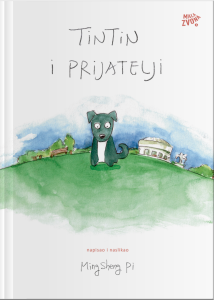
Tintin and his Friends

17,00 

A basket for mushroom picking, a blanket, and a little black dog – that’s how this story begins. Even though he was abandoned in the forest, the little dog was lucky: he was adopted by two nice people. “Tintin and his Friends” is a diary of the first year they spent together, recorded mainly from the dog’s perspective. We see various little events, from their life at home to from their walks in the park, feeling the warmth the three of them share and following Tintin’s adventures with various dog-friends. In a multitude of small scenes Mingsheng Pi – a Chinese painter based in Zagreb and Tintin’s owner – tells, almost without words, a gentle and cheerful story about animals and people, showing an exceptional talent to spot details and, with just a few strokes of his brush, to evoke a space, an atmosphere, characters, and their relations. Readers of all ages will enjoy Tintin’s adventures, and the youngest among them will learn something new about dogs and their humans – like the importance a dog may have for a with hearing-impaired person.

Croatian Folktales

17,00 

After reading old Croatian folktales in a very serious book for adults,author Sanja Lovrenčić decided to set her favourite ones free and make them more accessible to children of today, telling them in her own literary voice, adjusting them slightly so that they would be more understandable. In eleven short tales, we meet a wide range of interesting heroes and antiheroes, from fox brides and tiny fairies to ravenous young women and mean bunnies. Set in magical and mystical forest settings skillfully depicted by Branka Hollingsworth, these tales – sometimes whimsy, sometimes not – now get to live on in the minds and hearts of new generations of young readers and listeners, saved from the terrible destiny of being forgotten.

Kosjenka and Regoč

17,00 

One of the most popular fairy tales penned by Ivana Brlić Mažuranić, and one of those that Croatian children first encounter, is precisely the one about Regoč. However, even though the original story is entitled simply “Regoč”, the little fairy Kosjenka plays a more important role in it. Curious and lively, she sets the sluggish giant on an adventure. Cheerful when she finds company, compassionate in times of trouble, she sacrifices all her fairy magic for new friends, for children from two feuding villages near the Zlovoda lake. Although the two main characters belong to the realm of the fantastical, the story ends on a perfectly human note, with the construction of a new village. And while Regoč returns to his town of Legen, Kosjenka can no longer go back among the fairies, so she stays with the children from the village – as well as with little readers. For this silent book, visual artist Vendi Vernić told Ivana Brlić Mažuranić’s story in a purely visual language. For those who do not know the original, there is a small glossary at the beginning. Converted into pictures, the story becomes accessible to preschool readers.

The Little Key

17,00 

Starting from a banal event – a shoe that was untied and a key found on the street – the little heroine of this picture book talks about her loved ones. For each of them, such a key could serve something, unlock something of theirs: mom’s glass showcase, dad’s mysterious drawer, a compartment with love letters in grandma’s cabinet, a friend’s special pencil case, her brother’s box with figurines of dragons and knights. With each contemplation of the key, an image from everyday life is “unlocked”. But in the end, the girl concludes that the key will best serve her and her own imagination.
The author of this story about curiosity is the acclaimed and experienced writer Sanja Lovrenčić, and the book was illustrated by Lucija Mrzljak, an award-winning artist educated in Zagreb, Prague, Krakow and Tallinn.

A Reflection in the Rain

17,00 

Jasmina Kosanović, the author of a series of interesting and well-received picture books, does not seem to know how to tell a story about rain. Instead of words, images come to her, all airy and gentle – truly rainy. But for those who like to give themselves over to their imagination, every illustration in this picture book can be the beginning of an adventure. What are those people waiting for under their umbrellas? Who does a sad man with a scarf break up with? Who is behind the windows where the drops are pouring down? Where is the sailboat sailing under an almost clear, yet still rain-soaked sky? A series of rainy scenes results in the author seeing her own self clearly, sun kissed. Those who imagine a series of their own rainy stories will perhaps find out something about themselves, once they eventually emerge from Jasmina’s dreamy, watercolour world.

Meandering with Julije Knifer

18,00 

“Whenever I find something that I like, I want to tell a story about it” , says the narrator of this book. But she will by no means tell the story of Julije Knifer and his famous meander motif alone. The painter himself talks about anti-paintings and anti-bulbs, about the rhythms of black and white, vertical and horizontal lines, research and the search for extremes – all of this in his own words taken from original diary entries. And the illustrations inspired by his art also tell the readers about his journey towards and with meanders in their own way. In the fifth picture book of their Croatian fine art series, Sanja Lovrenčić and Dominik Vuković present the work of one of the most original and respected Croatian artists of the twentieth century, well-recognized abroad.