• 0 Knjige - 0,00 
    • Košarica je prazna.

Adults

Point Nemo

14,00 

Mladen Kopjar is an author with extensive experience in writing different types of literary texts. In “Point Nemo”, his first collection of poetry, this experience is reflected in the ease and skill with which he builds his poetic world, as well as in his thoughtful and consistent poetics. The origins of the poems are usually in everyday life, its spaces, objects, small events, memories, but thanks to the gift of observation and skillful selection of details, the author skillfully avoids the superficiality and banality of “realistic” writing. Freedom and imagination lead him from concrete experience to surreal images in which personal associations are mixed with various fragments from the ubiquitous virtual space. But the unique tone of this collection stems from the deep emotionality with which the whole is imbued; the author addresses (or talks about) his loved ones: wife, child, parents, meandering through areas of tenderness and pain. In that intimate space, the outside world is mirrored in flashes; the original clash between an authentically, intensely internal world and a diverse, sometimes aggressive external world gives this poetry strength and interest.

Dormitory

14,00 

Although it could seem that the primary origin of this poetry is the world of words – the author recurrently affirms the experience of reading as something very much alive and inspiring – the contact with her own material environment is equally important for Lidija Dujić. And no matter how linguistically complex, surprising, metaphorical this poetry is, and how far it takes (ironic) distance from reality, it always remains tied to the real moment that triggered poetic imagination and caused poetic language to flow. Singling out some moments, turning flashes of reality into a thoughtful linguistic structure, the poet creates original and meditative images, with a clear awareness of poetry as non-ordinary speech.

Red Doves

19,00 

The plot of this novel begins with the female narrator’s arrival on an unnamed Mediterranean island. She has inherited a house in an almost abandoned village and comes to see it; it is a good reason to get away from her daily struggles for a while. The landscape around her is nostalgically idyllic: crumbling stone houses, wild capers, homemade cheese, sunshine and wind. Everything suggests that there, at a distance from people, precarious jobs and urban routine, she’ll find a space for introspection, for facing her past, her desires and hopes. Along with the house, however, the narrator inherited a dovecot with a flock of pigeons bred by her deceased cousin, Toni. When she decides to release them from their prison, she has no idea that these homing birds will soon return to her along with six peculiar guests – Toni’s old friends. They organize a memorial party for him, and during three consecutive evenings they relate fragments of their shared past. Were they an international theater troupe that wandered the Mediterranean small towns in the seventies, or active participants in the political turmoil of the age of lead – it is difficult for the heroine to decide. At the end of the party, before they go away, the strange guests explain the true nature of her newly acquired inheritance: along with the house, she gets the obligation to tell their story, a story she did not fully grasp. And that’s where the Mediterranean idyll comes to an end: it will be replaced by a research into international terrorism in the 1970s, a personal revolt against the clash of wealth and poverty at that time and in the present, growing compassion for non-human living world and growing anger provoked by deadly business practices, cyber-subversions,  anger, fear and escape. To the fragments of her guests’ stories the heroine will react creating her own, a story that she will – when the storm she provoked subsides – almost unintentionally leave as a legacy to the new generation.

Deceptions and Spectres

16,00 
Book #3399

Travertine Bridge

11,00 

In “Travertine Bridge”, the author Jana Prević Finderle, based on her own experience and memories, introduces us to the life of travelers and the world of travel. The short travel sketches act like original postcards addressed to the reader; a concise description derived from the author’s impression of a place, fellow traveler, or guest turns into a vivid picture before our eyes. From a modest summer vacation on the Adriatic Sea in early childhood, to somewhat later family car trips to Paris and London, to independent wanderings around the world in adulthood, the author’s text, sometimes humorous, sometimes melancholic, and almost always nostalgic, seems somehow familiar to us and encourages us to embark on an adventure ourselves. The text is accompanied by drawings by Mate Rupić, who skillfully and thoughtfully transferred some of the vivid moments of Jana’s stories to paper using the ink technique.

A Short Trip Home and other Stories

14,00 
Book #3328


Paintings

12,00 

Paintings, a collection of prose poems, brings Segalen’s descriptions of imaginary Chinese visual art: thereby a dialogue is opened not only between different cultures, but also between different artistic media. The reader wanders around these foreign, strange places, sometimes lost, sometimes amazed but is always lead forwards by Segalen’s virtuoso writing.

Mala zvona brings the first integral Croatian translation of this poetic masterpiece.

Flush: a Biography

13,00 

How would a dog perceive the Victorian era? What would be this dog’s attitude towards his mistress – the great poet Elizabeth Barrett Browning? What happens when a biographical content is treated from a purely fictional perspective? These are the questions posed, and answered, in the short novel Flush; a Biography. In this playful, seemingly frivolous but very lucid, stylistically flawless text, Virginia Woolf is dealing with the issues of history, society conventions and social justice, while exploring in the extreme the possibilities of rendering of the perceptual perspective of an animal.

Plastron, Pericardium

10,00 

The third book of poetry by Lidija Dujić, Plastron, Pericardium, includes five cycles of poems: Growers of Ice, The Time of the Desert, A Plate of High Tide, Wagon Tracks and Crop Rotation and Bunker of Angels. It is a poetry full of daring images, unusual associative sequences, rich with references to various fields of human experience. Combining elements from different language levels, the (erudite) author shapes and produces her poetic reality, with its own optics and artistic logic.

Letters to his Wife 1914-1917

12,00 

My dearr heart, my lovely little one – thus begin the gentle letters Henri Barbusse wrote to his wife a hundred years ago. What follows is by no means gentle – trenches, shells, mud and the dead, the war that is revealed in its bloody meaninglessness. In the year 1914. the writer of letters, Henri Barbusse, was 41, had a reputation as a writer and editor, was not in the best health and had firm pacifist beliefs. Despite all this he volunteered for the French Army and spent the two first years of war on the front lines – and wrote his novel Under Fire, literary testimony of the World War I, which earned him the Goncourt  prize and thousands of readers. Documentary material on which is based his novel is found in the letters he wrote almost daily to his wife Hélyonne. In their immediacy and authenticity, those letters can convey to the reader of today the drama of the beginning of the “short twentieth century” better than any fiction.

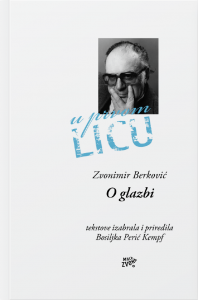
On Music

12,00 

A collectionof music critiques and essays by Croatian film director and erudite Zvonimir Berković. Texts he wrote over several decades for newspapers and magazines are collected in this book and divided into four parts: Critique – Portraits – Meditations – Conversations. Collected and edited by Bosiljka Perić Kempf.

Zvonimir Berković wrote about music only occasionally, in the mid sixties and the first half of the seventies, for several newspapers and magazines. He left chronicles of the music lives of festival cities as Dubrovnik and Vienna, but he also wrote reviews of both local and foreign artists’ performances during the Zagreb concert season. Most interesting, however, are the author’s imagination and subtle (and not only musical) taste in the portraits of musicians, interpreters and composers. Music had a deep impact in Berković’s work of movie director, especially in his “Rondo”, a Croatian classic made in 1966.


Searching for Ivana

18,00 

A biographical novel by Sanja Lovrenčić about the Croatian author Ivana Brlić Mažuranić. Written in the first-person singular, the story develops on two levels, in the past and in the present, unfolding around the changing and yet unchanging topics of family relations, artistic creation and female existence in the world of literature.

“K.Š.Gjalski” Award for the best Croatian novel in 2007.

Feminine Side of the Croatian Literature

14,00 

Exploring the feminine side of Croatian literature Lidija Dujić offers a concise and interesting overview of selected segment of the Croatian literary historyShe gives biographial sketches of Croatian female writers, explores the reception of their work and cliche images of women writers from the times of Renaissance to the contemporary age.  Analyzing and re-valuing some works, recognized under the label of “women’s literature”the author challenges many commonplace notions  writing in first person singularThe book is based on her doctoral dissertation, but is intended for a wider audience.

Good Morning, World!

10,00 

Diaries by the famous Croatian writer Ivana Brlić Mažuranić, written in the 1880s when she was fifteen to eighteen years old. The book provides insight into teenage life in the 19th century in Zagreb, the charming young character of the writer, her thoughts on literature, life and death, as well as the seeds of conflicts awaiting a female writer – all of which makes it a highly interesting read.