
Format: 13,5×20,5
ISBN: 978-953-8313-15-8
Pages: 170
Binding: paperback
Published: 2020.
16,00 € 9,60 €
Biography of Ludwig van Beethoven written by his contemporaries.
Format: 13,5×20,5
ISBN: 978-953-8313-15-8
Pages: 170
Binding: paperback
Published: 2020.
Over the last few decades Walter Benjamin has become one of the most prominent names in the humanities: considering definitions of modernity, film theory, philosophy of history, cultural studies or criticism of canonical literary texts, his work can hardly be avoided. This is brought about by Benjamin’s broad interests and lucidity, but also by his awareness of the fact that cultural theory or philosophy always implies an act of writing. His penchant towards the use of metaphor, image, allusion rather than systematical argumentation and his insistence on a purified stile rather than a strict composition make Benjamin’s texts – that always place themselves between philosophy and literature – a field of knowledge that never allows an unambiguous interpretation. In his Berlin Childhood around 1900 the dominant element is precisely this ‘surplus’ of literature; applying an autobiographical discourse, Benjamin creates a lyrical picture of his childhood in a rich bourgeois family from Berlin. Nevertheless, this seemingly personal thematic becomes a historically relevant document that bears witness to the life and culture of the big city, evoking a great number of social and philosophical issues: the constitution of subject through memory, the shadow of class struggle, the possibility of objective historical representation, the relation between modernism and messianism. Starting from a specific literary genre, Berlin Childhood around 1900 amplifies the tension between philosophy and literature, the tension that makes them both possible: thus Benjamin anticipates some of the most important themes and techniques of post-structuralism, and stays as modern as ever.
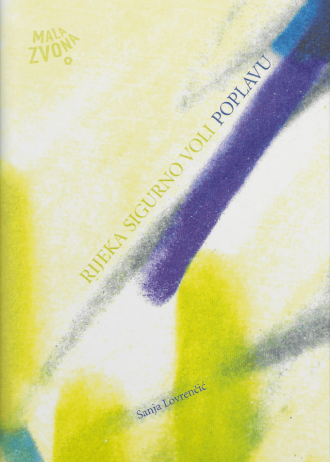
In her first poems Sanja Lovrenčić distanced herself in an elitist manner from the descriptiveness of reality and its usual subjects, but now in the collection A River Certainly does Love the Flood she approaches them in a relaxed manner equipped with elements of fairy tales – dreaminess, flax-ness and cotton-ness. Suddenly, for her, everything is utterable, without the pronounced use of the notional labyrinth or the figurative debris prominent with some other writers (…) Sometimes she would reach for the images that are close to a child’s concept of the world. Naturally, it is only an excuse. We are dealing here with a skilful mimicry of childlike tameness and imagination by the complexity and even aggression of adulthood. For our times, the author is really a gentle poet (but not a coy nor a complaining one) who by no means wants to use parasitic additions to make beauty, but neither does she want to use those purely technical, artificial means with “witchcraft” intentions. She is interested in a “walk with pebbles”. In all probably this is what contributed to her being the laureate of the Kiklop Award for the best poetry collection in the year 2007. (Sead Begović)
Kiklop Award for the best poetry book, 2007.
The text of these Notes flows like a mountain stream or breeze: it describes scenes from writers’ residences in which the author stayed for a little over a year, and the reflections associated with these places make up the bulk of the book. These are notes about the journey, woven with the subtle skill of a top connoisseur of language and working with words. Atmosphere, associations and images are innumerable; thoughts, questions – we recognize them all, we ask ourselves all that. But here and there, as when the folds of a fabric are separated by a gust of wind, readers see that this is not all: from the notes made between the trips they catch hints of the horizon of harsh and stupid reality that led the author to go on the road again and again. “You cover reality with a veil and you see better,” she writes in this book. Traveling with clear thoughts and open eyes, Sanja Lovrenčić covers and reveals reality with a unique fabric woven of words. (Iva Valentić, ed.)
Self-Portrait in the Study, the recently published autobiography of one of the leading contemporary continental philosophers Giorgio Agamben offers the reader a wide set of interesting motives. Throughout the book, the author recalls all the intellectual encounters which had a decisive influence on his thought, creating, in this way, a magnificent portrait of the late 20th century philosophical and literary scene: following Agamben from encounter to encounter, the reader meets Martin Heidegger, Guy Debord, Giorgio Manganelli, Elsa Morante, Ingeborg Bachmann, Gershom Scholem… The descriptions of these meetings and friendships are interlaced with authentic philosophical meditations on painting, language, poetry, history and inheritance, and, in the final analysis, with glimpses of that “universal science of man” about which Agamben dreamt together with Italo Calvino and Claudio Rugafiori. Agamben’s autobiography thus offers a lyrical synthesis of the three elements whose endless perturbations characterize the whole of the philosopher’s oeuvre: literature, philosophical discourse and a private life that must remain hidden forever.
Book #2912
