-
 In the Direction of the Beginning (Early Short Stories)
× 1
In the Direction of the Beginning (Early Short Stories)
× 110,00 €6,00 €
Ukupno : 6,00 €

 In the Direction of the Beginning (Early Short Stories)
Ukupno : 6,00 €
13,00 € 7,80 €
“In the Rhythm of Horror – The Abyss of Dances” is a collection of six fantasy stories by young Croatian authors. The stories were chosen via a competition that Mala zvona held in 2020, after which authors Josip Čekolj, Mateja Pavlic, Marin Pelaić, Ines Vajzović, Martina Vidaić and Orin Ivan Vrkaš were chosen. Except for the characteristic fantastical elements of the unexpected and wondrous, the motive of dance also connects the stories – a dance of the dead and the arisen, a dance of half-humans and half-animals in the moonlight, an oriental dance of wraiths in black capes. These obnoxious dancers contribute to an uneasy atmosphere but at the same time, they create an aura of mystical beauty. Each story is illustrated with a black and white piece by Klara Rusan Klarxy – her work masterly depicts the merge of the real and the otherworldly, and makes a world that might seem dark and bizarre mysteriously alluring.
Format: 15×21
ISBN: 978-953-8313-30-1
Number of pages: 112
Hardcover
Published: 2021.
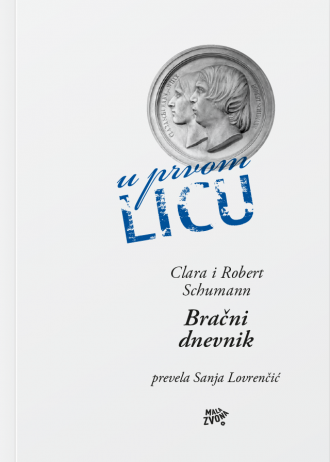
The edition that will thrill every classical music lover! The year is 1840, in the city of Leipzig; the young but already internationally famous pianist Clara Wieck and the still quite unknown composer Robert Schumann just succeeded in getting married, despite various obstacles. The day after the wedding, upon Robert’s whish, they start writing down all their needs and desires, joys and sorrows of matrimonial life. They take turns in writing, each of them covering the events of one week, at first with a lot of passion. Many celebrated musicians of the period pass through the pages of their double diary; Robert and Clara speak about art, home concerts, days and weeks filled with music, but they also speak about love. In these first years of their marriage, years that have been among the most productive for Robert and a sort of setback for Clara, life is good, but it isn’t without its’ own shadows…
Self-Portrait in the Study, the recently published autobiography of one of the leading contemporary continental philosophers Giorgio Agamben offers the reader a wide set of interesting motives. Throughout the book, the author recalls all the intellectual encounters which had a decisive influence on his thought, creating, in this way, a magnificent portrait of the late 20th century philosophical and literary scene: following Agamben from encounter to encounter, the reader meets Martin Heidegger, Guy Debord, Giorgio Manganelli, Elsa Morante, Ingeborg Bachmann, Gershom Scholem… The descriptions of these meetings and friendships are interlaced with authentic philosophical meditations on painting, language, poetry, history and inheritance, and, in the final analysis, with glimpses of that “universal science of man” about which Agamben dreamt together with Italo Calvino and Claudio Rugafiori. Agamben’s autobiography thus offers a lyrical synthesis of the three elements whose endless perturbations characterize the whole of the philosopher’s oeuvre: literature, philosophical discourse and a private life that must remain hidden forever.
Book #2912
Over the last few decades Walter Benjamin has become one of the most prominent names in the humanities: considering definitions of modernity, film theory, philosophy of history, cultural studies or criticism of canonical literary texts, his work can hardly be avoided. This is brought about by Benjamin’s broad interests and lucidity, but also by his awareness of the fact that cultural theory or philosophy always implies an act of writing. His penchant towards the use of metaphor, image, allusion rather than systematical argumentation and his insistence on a purified stile rather than a strict composition make Benjamin’s texts – that always place themselves between philosophy and literature – a field of knowledge that never allows an unambiguous interpretation. In his Berlin Childhood around 1900 the dominant element is precisely this ‘surplus’ of literature; applying an autobiographical discourse, Benjamin creates a lyrical picture of his childhood in a rich bourgeois family from Berlin. Nevertheless, this seemingly personal thematic becomes a historically relevant document that bears witness to the life and culture of the big city, evoking a great number of social and philosophical issues: the constitution of subject through memory, the shadow of class struggle, the possibility of objective historical representation, the relation between modernism and messianism. Starting from a specific literary genre, Berlin Childhood around 1900 amplifies the tension between philosophy and literature, the tension that makes them both possible: thus Benjamin anticipates some of the most important themes and techniques of post-structuralism, and stays as modern as ever.