-
 Scorpion-Fish
× 1
Scorpion-Fish
× 110,00 €6,00 €
Ukupno : 6,00 €

 Scorpion-Fish
Ukupno : 6,00 €
13,00 € 7,80 €
“In the Rhythm of Horror – The Abyss of Dances” is a collection of six fantasy stories by young Croatian authors. The stories were chosen via a competition that Mala zvona held in 2020, after which authors Josip Čekolj, Mateja Pavlic, Marin Pelaić, Ines Vajzović, Martina Vidaić and Orin Ivan Vrkaš were chosen. Except for the characteristic fantastical elements of the unexpected and wondrous, the motive of dance also connects the stories – a dance of the dead and the arisen, a dance of half-humans and half-animals in the moonlight, an oriental dance of wraiths in black capes. These obnoxious dancers contribute to an uneasy atmosphere but at the same time, they create an aura of mystical beauty. Each story is illustrated with a black and white piece by Klara Rusan Klarxy – her work masterly depicts the merge of the real and the otherworldly, and makes a world that might seem dark and bizarre mysteriously alluring.
Format: 15×21
ISBN: 978-953-8313-30-1
Number of pages: 112
Hardcover
Published: 2021.
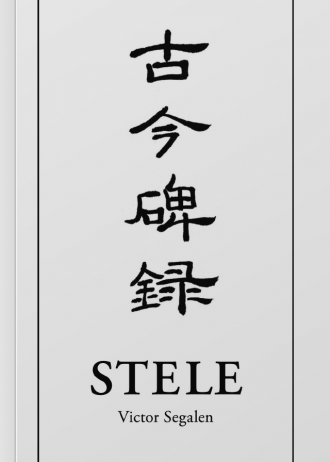
Integral text of the famous poetry collection “Steles” by Vicotr Segalen, one of the classic works of French modernism, for the first time in the Croatian translation, with new calligraphies of Chinese epigrams. Translated by Stephane Michel, Senka Sedmak and Sanja Lovrenčić; calligraphied by Iva Valentić and Ming Sheng Pi.
A literery testimony of an outward and inward journey by the renowned Swiss traveler and writer. What could have eassily become a simple travelogue becomes a diary of a slow sinking into loneliness, fever, exotic beauties and deadly menaces of a “chimerical island” – Sri Lanka. Combining humour and poetry, N. Bouvier created penetrating, unforgettable literary images.
In this book that addresses every generation words and images blend into an impressive poetical unity. Using drawings with simple, clear lines and concise sentences, the author tells a story that’s possible to read and experience on different levels. She talks about the close connection of human beings with nature, about changes and the importance of that – sometimes concealed, but still permanent – relationship. The tree is also a symbol of the author’s inner being, a deep and vital center where her strength arises from, a strength of the utmost importance in encounters with the outside world and collisions with its walls.