-
 Serna and Mack in Pursuit of the Frightened Month
× 2
Serna and Mack in Pursuit of the Frightened Month
× 215,00 €9,00 €
Ukupno : 18,00 €

 Serna and Mack in Pursuit of the Frightened Month
Ukupno : 18,00 €
Hilda is an adventurous chicken (rare thing in a chicken house); she embarks on a long journey, searching for the river Limpopo. Her adventures are told in words and pictures, in a series of postcards that she sends to her friends who have stayed home (as a normal chicken should). Her postcards are never just landscapes; the picture always shows someone she met on the road: two ladybugs who lost their sister, a pig prince, a walking hill, a cat teacher teaching only the letter A, and a number of other characters whose stories she tells in just a few words. They make a pleasant reading, full of little surprises that excite wonder and laughter.
Age: 4-6
Leo is sitting in front of the house, lounging in a chair and thinking about the past year. The summer was great and promised a good start to seventh grade: with his brother and some friends he had founded a rock band that played a crazy summer hit, played in an international orchestra in Slovenia, and also, he had bathed in the sea. But when he returned to the city, things started going downhill – their pet, a brown rabbit, disappeared without trace, seventh grade started “badly”, with a pile of books, endless assignments and papers, and disagreement broke out with the new fencing coach … Sanja Lovrenčić enriched Croatian youth prose with a realistic and entertaining novel which, through the eyes of the smart, witty and talkative boy Leo, his family and friends, makes us aware (or reminds us) of the problems of growing up. Through the clarity of a child’s mind, we are faced with the absurdities of the adult world, as well as absurdities in schooling (very well described in the chapter “When you write about spring for the seventh time”). Adolescence has never been easy, but this novel shows that it can and should be fun!
(recommendation of the Vladimir Nazor Library in Zagreb)
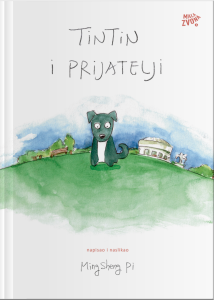
A basket for mushroom picking, a blanket, and a little black dog – that’s how this story begins. Even though he was abandoned in the forest, the little dog was lucky: he was adopted by two nice people. “Tintin and his Friends” is a diary of the first year they spent together, recorded mainly from the dog’s perspective. We see various little events, from their life at home to from their walks in the park, feeling the warmth the three of them share and following Tintin’s adventures with various dog-friends. In a multitude of small scenes Mingsheng Pi – a Chinese painter based in Zagreb and Tintin’s owner – tells, almost without words, a gentle and cheerful story about animals and people, showing an exceptional talent to spot details and, with just a few strokes of his brush, to evoke a space, an atmosphere, characters, and their relations. Readers of all ages will enjoy Tintin’s adventures, and the youngest among them will learn something new about dogs and their humans – like the importance a dog may have for a with hearing-impaired person.
In “Travertine Bridge”, the author Jana Prević Finderle, based on her own experience and memories, introduces us to the life of travelers and the world of travel. The short travel sketches act like original postcards addressed to the reader; a concise description derived from the author’s impression of a place, fellow traveler, or guest turns into a vivid picture before our eyes. From a modest summer vacation on the Adriatic Sea in early childhood, to somewhat later family car trips to Paris and London, to independent wanderings around the world in adulthood, the author’s text, sometimes humorous, sometimes melancholic, and almost always nostalgic, seems somehow familiar to us and encourages us to embark on an adventure ourselves. The text is accompanied by drawings by Mate Rupić, who skillfully and thoughtfully transferred some of the vivid moments of Jana’s stories to paper using the ink technique.
“We, the Mice”, a new picture book by Pika Vončina, is a sequel to her series of picture books about a fantastic animal world. Four stories about a harmonious family of mice are told by Erik the Unstoppable, the mouse who got his nickname because he constantly asks curious questions. His family does not live in “holes” but in nice and comfy dwellings, eating a variety of fruits and vegetables (sometimes even cheese!), loving music and gardens…
The text is handwritten in large block letters, which allows younger children to read it on their own, and helps them as an additional motivation in the process of learning to read and write. The diversity of characters and settings stimulates the development of children’s imagination and deepens their perception and emotional intelligence.
Ages 4-7
Vesna Matana Matić, an experienced musician with pedagogical experience, in her playful fantasy on the subject of classical music and modern technology, conjures up the great composer surrounded by his numerous children. Children’s cries, laughter and insistent questions are the lively background against which Johann Sebastian’s works are created – until the moment when the composer calls for help from the future, so that he can work in peace. Help does indeed arrive, in the form of a little girl, Selfiene, who gives Bach’s children smartphones. A silence ensues in which no one even notices the house cat any more. But this silence is not in the least stimulating: the melodies in the composer’s head have also fallen silent… This picture book is designed so that the youngest readers can learn something about classical music in a fun way, but also to reflect on the changes that electronic devices have brought to family life. The text is accompanied by imaginative illustrations by the young artist Doria Jantolić.
At first glance, this unusual picture book seems to be entirely dedicated to the endless diversity of winds. But in fact, it questions the ways in which people experience and describe the world. The main character of the story, Tanja the Windwalker, initially performs her job in accordance with the rules and expectations of the wind observation service. However, over time, this passionate wind lover is no longer satisfied with the ordinary language of official reports; she begins to write differently – more personally and poetically, and it takes her more time to formulate sentences. At the same time, various wind officials find it increasingly difficult to understand her… The author of the text, Igor Rajki, conjures up Tanja’s experiences in the worlds of wind and language with strange new coinages and quirky puns, while the illustrator Klasja Habjan creates an imaginative visual world in harmony with the story.
This prose-poetry reader could prove to be one of the key events of the Anglo-Croatian literary exchange in 2025: in it, translator and poet Goran Čolakhodžić brings a selection of prose and verse by the English early modernist, Edward Thomas, one of the most important voices of British poetry and of the generation of artists who perished in the Great War, and a close friend of the American classic Robert Frost. The rhythms of his verse are quiet and unobtrusive; he was above all a poet of the earth, trees, birds, and the human relationship with nature, but his poetry is also characterized by subtle psychological insights and is overshadowed by the coming world conflict. In addition to tackling Thomas’s rhymed verse and selecting some of the most successful fragments from Thomas’s nature writing, travel journals and articles, Čolakhodžić also wrote a critical preface, notes and his own artistic text juxtaposed with Thomas’s – a diary of the arrival of spring in Zagreb in 2025, which highlights the similarities and differences between England and Croatia, the 19th and 21st centuries, reminding us of the impact that climate change and people’s problematic relationship with nature have on our daily life. The painter Iva Valentić provided stunning artistic responses to the texts collected here, connecting Far Eastern techniques with Western literature.