• 0 Knjige - 0,00 
    • Košarica je prazna.

Croatian Folktales

17,00  10,20 

After reading old Croatian folktales in a very serious book for adults,author Sanja Lovrenčić decided to set her favourite ones free and make them more accessible to children of today, telling them in her own literary voice, adjusting them slightly so that they would be more understandable. In eleven short tales, we meet a wide range of interesting heroes and antiheroes, from fox brides and tiny fairies to ravenous young women and mean bunnies. Set in magical and mystical forest settings skillfully depicted by Branka Hollingsworth, these tales – sometimes whimsy, sometimes not – now get to live on in the minds and hearts of new generations of young readers and listeners, saved from the terrible destiny of being forgotten.

Notes from Encountered Lands

17,00  10,20 

Miroslav Kirin’s book of travelogues brings together notes from different periods of the author’s life, but thanks to the coherence of his view and characteristic stylistic refinement, makes an organic whole. You could call it a kind of triptych: it starts with notes from Paris in 2005, the middle and most complex part is dedicated to the author’s sojourns in China, and the book ends with very short notes from various trips through Croatia. The author’s observations move in a wide range: from very simple everyday little things that catch his eye to the broad cultural issues of the Far East. Despite the variety of motives seen in the “encountered lands”, the traveler’s eye shows the same curiosity and the same clarity. The moments he records often turn into micro-stories, and out of the multitude of human outlines that appear in his notes and notebooks, some gain fullness and turn into impressive characters. Poetry runs through Kirin’s notes as a kind of weft – sometimes as initiator of travel, sometimes as an object of work and thought, sometimes as a latent awareness of the poetic values of language. Therefore, this book can give pleasure to both travel lovers and to all those who enjoy good literature.

Tintin and his Friends

17,00  10,20 

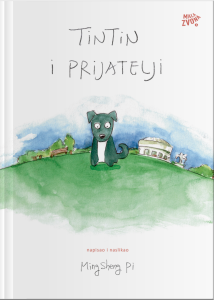
A basket for mushroom picking, a blanket, and a little black dog – that’s how this story begins. Even though he was abandoned in the forest, the little dog was lucky: he was adopted by two nice people. “Tintin and his Friends” is a diary of the first year they spent together, recorded mainly from the dog’s perspective. We see various little events, from their life at home to from their walks in the park, feeling the warmth the three of them share and following Tintin’s adventures with various dog-friends. In a multitude of small scenes Mingsheng Pi – a Chinese painter based in Zagreb and Tintin’s owner – tells, almost without words, a gentle and cheerful story about animals and people, showing an exceptional talent to spot details and, with just a few strokes of his brush, to evoke a space, an atmosphere, characters, and their relations. Readers of all ages will enjoy Tintin’s adventures, and the youngest among them will learn something new about dogs and their humans – like the importance a dog may have for a with hearing-impaired person.

Stories for the End of the World (and Other Everyday Trifles)

17,00  10,20 

Don’t let the title fool you – in these witty micro-stories the end of the world is happening on an (almost) everyday level and “other trifles” may have an unexpected depth. Miniatures by Sanja Lovrenčić, organized in eight “chapters”, seemingly adapted to the short attention span of a modern reader, take into account things like morning-garbage-squads, polar bear wisdom, exodus of delivery people, time-stay-machines, mythical journeys and metaphorical animals. Sometimes entertaining, sometimes meditative, the author’s voice stays firm in defending the art of painting/playing with words and especially vocal against false/alternative literature that (allegedly) paints reality, media, and politics.  

Darkville

17,00  10,20 

Addressing the children for the first time, the renowned Darkville, the setting and the main character of this picture book written by a distinguished author Iva Bezinović-Haydon, is a sad town: all plants are being systematically cut there. No one really knows whose idea that was, but two city officials play a significant role in its implementation. One of them stamps the word ‘NO’ on all requests for a change, the other maintains order with his cutting tools – until a little blue flower emerges from a crack in the asphalt and everything starts to change… Using simple words and an appealing plot, the author talks about the need humans feel for the living green world, for colors, diversity and freedom, but also about different ways of standing up to bad rules imposed from somewhere above – it can be done in a hidden manner, in private spaces, or openly, in public, joining forces with other people. The young illustrator Laura Martinović brought the story about Darkville to life with her playful and warm illustrations, full of creative visual ideas and details that enrich the text.   

Forgotten Things

17,00  10,20 

In her second artist’s book, Agata Lučić takes readers of all generations to a flea market – an almost monochromatic blue world filled with various objects. Each thing there carries traces of time spent in someone’s life, traces of somebody’s past. The young visual artist evokes fragments of life that “forgotten things” shared with their humans in her original, very recognizable style, gradually creating a warm atmosphere – with bits of magic. The last double-page holds a surprise: as the objects manage to attract new owners and are being accepted along with their stories, various colors enter the world of the picture book. It is no longer a space of memories; it becomes a living space. “Forgotten Things” are both nostalgic and cheerful, they urge the reader to open up to hidden histories of unknown people and certain values accessible only to a watchful eye; they invite both children and adults to dream, offering a world of peculiar visual pleasure. 

We acquire and discard things too easily, warns the author of this gentle and playful picture book; but even when they have already been discarded, left to their fate on the stands of some open-air “mini market”, they can be looked at, singled out from the crowd, appropriated, restored, and brought back to life.


Book #4909

Rascals in the Gutter

17,00  10,20 

In the best tradition of young adult novels, but with a fresh voice, Josip Čekolj recounts the story of his rascals — four friends on the brink of adulthood. Although the town through which they roam is imaginary, their love and confusion, their conflicts and blunders, much like their need for warmth and belonging are all very real. As the rascals learn to find their way ‘in the gutter’, various characters show up to guide them along. Some are more trustworthy than others, and they largely come from the fringes of society, with perhaps the most important being an old lady with her cats and flair for poetry. And as usually happens in coming-of-age stories, their wading through murky waters becomes a first step towards maturity. The inspiration for this book was the exhibition ‘Rascals and Frogs’ by the visual artist Dominik Vuković, themed around memories of childhood. He illustrated this edition in close collaboration with the author, resulting in a special relationship between the text and illustrations.

The Female World of the British Raj

17,00  10,20 

Biljana Romić, born in 1960, is a Croatian indologist and cultural editor. She gained her Master of Arts title in 1997 in Zagreb, with a study of Bharati Mukherjee and postcolonial migrant faiths. She has ever since actively been researching and writing about postcolonialism and the notion of the Other. Her extensive study The women’s world of British India was written after she spent several years studying diaries and letters written by “memsahibs”. Her work is not simply a historical overview of their lives and roles during colonialism, it puts colonial history, literature and the notion of the “Other” in a contemporary critical context; Romić analyses over one hundred and fifty sources, including Indrani Sen, Amandeep Kaur, Kumari Jayawardena and Shashi Tharoor. When reading about the British colonial venture in India, we mostly encounter works that have been written from the male perspective of conquests and regimen – but colonial women have, almost from the very beginning, been a part of this venture. Biljana Romić’s book brings us the voices of these women and their lives. They journeyed into the unknown, often not prepared for the adversities of a different climate and the social roles they were going to find themselves in. They went into the unknown as wives, governesses, teachers, as young women in search of a husband; sometimes as entrepreneurs, missionaries, adventurers. Many stayed within the expected roles given by the British colonial community, but some of them showed that it is possible to overcome the limitations of their era, class and gender when it comes to their relation to India and Indians. Biljana Romić talks about the so-called “little history”, the one that appears on the margins of big historical events – and without which it is impossible to gain a complete picture of a time that has passed.

A Handful of Night Journeys

16,00  9,60 

The fourth poetry book by the young award-winning poet Josip Čekolj takes the reader on unexpected journeys through literary worlds. On the nocturnal reading and writing paths, poems in the form of acrostics are created. For these, the poet chooses the first sentences from novels that in some way marked his childhood and youth. In this way, he creates an original dialogue between poetry and prose, erasing the boundaries between older and contemporary literature and between works for children and adults. The diversity of poetic images in this little linguistic masterpiece does not contradict the unity of the whole, which is based on a kind of substrate of the author’s reflection on the world. Acting in the dual role of reader and writer, Čekolj creates verses that spring from personal memories and experiences, resonating with broader social and political problems. The collection is full of strange stylistic figures and unusual syntactic turns, which on the one hand consistently maintain the concept of an acrostic, and on the other reflect the author’s imaginative and creative freedom. With its sense of rhythm and sonority of language, “A Handful of Night Journeys” builds on Čekolj’s previous books, but it also opens up a new poetic direction along the tracks of lyrical language – a conceptually well-thought-out and stylistically rounded work that captivates with its freshness and layered vision.

Jezikova juha / Tongue Soup

16,00 

The old cake lady is gone!
Roses aren’t blooming for me!
His axe struck honey!

Visual artist Petra Balekić interprets in her own way – using images and words – just some of the  many coluorful expressions often heard in spoken Croatian. For those who know the language will be reminded od them and have a laugh, while those who don’t will be amazed and learn them with the help of the English translations – and thus avoid getting “tongue soup” for being ignorant.

Windwalk

16,00  9,60 

At first glance, this unusual picture book seems to be entirely dedicated to the endless diversity of winds. But in fact, it questions the ways in which people experience and describe the world. The main character of the story, Tanja the Windwalker, initially performs her job in accordance with the rules and expectations of the wind observation service. However, over time, this passionate wind lover is no longer satisfied with the ordinary language of official reports; she begins to write differently – more personally and poetically, and it takes her more time to formulate sentences. At the same time, various wind officials find it increasingly difficult to understand her… The author of the text, Igor Rajki, conjures up Tanja’s experiences in the worlds of wind and language with strange new coinages and quirky puns, while the illustrator Klasja Habjan creates an imaginative visual world in harmony with the story.

The Creepy House

16,00  9,60 

The Creepy House is a skilful blend of a story about a family intending to move from the city to an old house surrounded by nature, an old-fashioned game of riddles, and fairy-tale elements that lend the whole book an air of fantasy that children find so irresistible. Solving the riddles given to them by the mysterious voice from the fireplace, Florijan and Klara explore the house and the garden, noticing so many things they did not see at first. With a bit of fear and lots of laughter, they experience a real adventure in search of a key they will use to ‘unlock’ the magic of their future home… The author shows a very good understanding of a child’s way of thinking and combines an imaginative plot with a subtle educational element about the world of plants and animals. The illustrator follows the story closely, complementing it with a number of small artistic surprises.

Ema is Alone

16,00  9,60 

The story about Ema – written by Vanja Marković, an expert in inclusive and social pedagogy – deals with an important topic of our time: the way people perceive each other. Roaming the streets of her hometown, the little heroine is trying to find someone to play with. She encounters a whole bunch of various characters, but they notice only her looks – her shaggy hair, her huge eyes, her dirty jacket. They all nag her and none of them wants to follow her imagination, but her ideas for games remain on pages, as possibilities for readers themselves to develop. In the end even Ema repeats the pattern that surrounds her: when a yellow cat asks her to play with it she refuses the invitation, thinking that a black cat would be much more interesting. In a playful way the story opens the readers’ eyes to the wrongs implied in superficial ways of looking at others. The storyteller’s style is simple and flowing, very well adapted to the target group of readers (6-8). The illustrations by Vibor Juhas complement and enrich the text; they are close to the aesthetics of comic books and full of little visual surprises.

Deceptions and Spectres

16,00  9,60 
Book #3399

The Sneering Bird

16,00  9,60 

Illustrating a fable about a parrot run away from the ZOO who meets various animals and finds all of them for some reason ridiculous until a fox teaches it a lesson, the artist Ivana Pipal finds ingenious ways of representing basically the same situation: the parrot and another animal. Giving each protagonist mood and personality, and creating at the same time deeply pleasant green world of the woods, she turns the tale about understanding and accepting others into rich visual pleasure.


Book #3396