• 0 Knjige - 0,00 
    • Košarica je prazna.

First Person Singular Book Series

Notes from the Source, Questions for Later

21,00 

An architect with previous experience as author, in his new book conceived as a sort of travel journal, Tomislav Pavelić reflects on the (co)relationships between man and nature, space and place, history and the present. At the end of his often erudite considerations, he asks questions that serve as both the starting point and the destination of these journeys. Without offering hasty answers, he invites us to approach universal problems with an open mind, illustrated in concrete examples of the regions visited, which form the colorful and dynamic decor of this book: places like Armenia, Sicily, Andalusia, Albania etc. All of these locations and cultures can teach us something about the past, but at the same time they allow us a clearer view into the murky and uncertain future of our civilization.

#openwindow

15,00 

This collection of short texts enitled “#openwindow” is an outstanding example of how high-quality and original literature can be created on social media. For a year, author Aida Bagić wrote morning notes while looking out the window in her bedroom and published them on social media, with accompanying photographs. This project was called #openwindow, and resulted in a variety of texts – prose and poetry fragments, comments on daily events, notes on dreams and memories, wordplay and sketches of fairy tales. Often meditative, sometimes factual or playful, they reveal that the author is a skilled writer with an experience in writing poetry. Collected in this book, these notes show how an everyday object can stimulate our imagination, reflection, and introspection. Created in front of a window that opens onto external landscapes, they outline the author’s world of thought and emotion as a unique and interesting inner landscape. These texts are also an invitation to readers to think about their own everyday life, about ways in which they could rethink it so that it is not only more bearable, but also a source of genuine curiosity, sometimes even joy.

Notes from Encountered Lands

17,00 

Miroslav Kirin’s book of travelogues brings together notes from different periods of the author’s life, but thanks to the coherence of his view and characteristic stylistic refinement, makes an organic whole. You could call it a kind of triptych: it starts with notes from Paris in 2005, the middle and most complex part is dedicated to the author’s sojourns in China, and the book ends with very short notes from various trips through Croatia. The author’s observations move in a wide range: from very simple everyday little things that catch his eye to the broad cultural issues of the Far East. Despite the variety of motives seen in the “encountered lands”, the traveler’s eye shows the same curiosity and the same clarity. The moments he records often turn into micro-stories, and out of the multitude of human outlines that appear in his notes and notebooks, some gain fullness and turn into impressive characters. Poetry runs through Kirin’s notes as a kind of weft – sometimes as initiator of travel, sometimes as an object of work and thought, sometimes as a latent awareness of the poetic values of language. Therefore, this book can give pleasure to both travel lovers and to all those who enjoy good literature.

The Female World of the British Raj

17,00 

Biljana Romić, born in 1960, is a Croatian indologist and cultural editor. She gained her Master of Arts title in 1997 in Zagreb, with a study of Bharati Mukherjee and postcolonial migrant faiths. She has ever since actively been researching and writing about postcolonialism and the notion of the Other. Her extensive study The women’s world of British India was written after she spent several years studying diaries and letters written by “memsahibs”. Her work is not simply a historical overview of their lives and roles during colonialism, it puts colonial history, literature and the notion of the “Other” in a contemporary critical context; Romić analyses over one hundred and fifty sources, including Indrani Sen, Amandeep Kaur, Kumari Jayawardena and Shashi Tharoor. When reading about the British colonial venture in India, we mostly encounter works that have been written from the male perspective of conquests and regimen – but colonial women have, almost from the very beginning, been a part of this venture. Biljana Romić’s book brings us the voices of these women and their lives. They journeyed into the unknown, often not prepared for the adversities of a different climate and the social roles they were going to find themselves in. They went into the unknown as wives, governesses, teachers, as young women in search of a husband; sometimes as entrepreneurs, missionaries, adventurers. Many stayed within the expected roles given by the British colonial community, but some of them showed that it is possible to overcome the limitations of their era, class and gender when it comes to their relation to India and Indians. Biljana Romić talks about the so-called “little history”, the one that appears on the margins of big historical events – and without which it is impossible to gain a complete picture of a time that has passed.

Travertine Bridge

11,00 

In “Travertine Bridge”, the author Jana Prević Finderle, based on her own experience and memories, introduces us to the life of travelers and the world of travel. The short travel sketches act like original postcards addressed to the reader; a concise description derived from the author’s impression of a place, fellow traveler, or guest turns into a vivid picture before our eyes. From a modest summer vacation on the Adriatic Sea in early childhood, to somewhat later family car trips to Paris and London, to independent wanderings around the world in adulthood, the author’s text, sometimes humorous, sometimes melancholic, and almost always nostalgic, seems somehow familiar to us and encourages us to embark on an adventure ourselves. The text is accompanied by drawings by Mate Rupić, who skillfully and thoughtfully transferred some of the vivid moments of Jana’s stories to paper using the ink technique.

Letters to his Wife 1914-1917

12,00 

My dearr heart, my lovely little one – thus begin the gentle letters Henri Barbusse wrote to his wife a hundred years ago. What follows is by no means gentle – trenches, shells, mud and the dead, the war that is revealed in its bloody meaninglessness. In the year 1914. the writer of letters, Henri Barbusse, was 41, had a reputation as a writer and editor, was not in the best health and had firm pacifist beliefs. Despite all this he volunteered for the French Army and spent the two first years of war on the front lines – and wrote his novel Under Fire, literary testimony of the World War I, which earned him the Goncourt  prize and thousands of readers. Documentary material on which is based his novel is found in the letters he wrote almost daily to his wife Hélyonne. In their immediacy and authenticity, those letters can convey to the reader of today the drama of the beginning of the “short twentieth century” better than any fiction.

On Music

12,00 

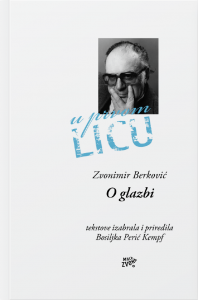
A collectionof music critiques and essays by Croatian film director and erudite Zvonimir Berković. Texts he wrote over several decades for newspapers and magazines are collected in this book and divided into four parts: Critique – Portraits – Meditations – Conversations. Collected and edited by Bosiljka Perić Kempf.

Zvonimir Berković wrote about music only occasionally, in the mid sixties and the first half of the seventies, for several newspapers and magazines. He left chronicles of the music lives of festival cities as Dubrovnik and Vienna, but he also wrote reviews of both local and foreign artists’ performances during the Zagreb concert season. Most interesting, however, are the author’s imagination and subtle (and not only musical) taste in the portraits of musicians, interpreters and composers. Music had a deep impact in Berković’s work of movie director, especially in his “Rondo”, a Croatian classic made in 1966.


Searching for Ivana

18,00 

A biographical novel by Sanja Lovrenčić about the Croatian author Ivana Brlić Mažuranić. Written in the first-person singular, the story develops on two levels, in the past and in the present, unfolding around the changing and yet unchanging topics of family relations, artistic creation and female existence in the world of literature.

“K.Š.Gjalski” Award for the best Croatian novel in 2007.

Feminine Side of the Croatian Literature

14,00 

Exploring the feminine side of Croatian literature Lidija Dujić offers a concise and interesting overview of selected segment of the Croatian literary historyShe gives biographial sketches of Croatian female writers, explores the reception of their work and cliche images of women writers from the times of Renaissance to the contemporary age.  Analyzing and re-valuing some works, recognized under the label of “women’s literature”the author challenges many commonplace notions  writing in first person singularThe book is based on her doctoral dissertation, but is intended for a wider audience.

Good Morning, World!

10,00 

Diaries by the famous Croatian writer Ivana Brlić Mažuranić, written in the 1880s when she was fifteen to eighteen years old. The book provides insight into teenage life in the 19th century in Zagreb, the charming young character of the writer, her thoughts on literature, life and death, as well as the seeds of conflicts awaiting a female writer – all of which makes it a highly interesting read.