

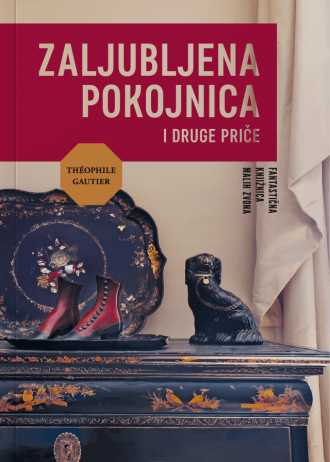
“La Morte Amoureuse” and Other Stories
A selection of fantastic short stories by the French classic Théophile Gautier, in Croatian translation.

13,00 € 7,80 €
“In the Rhythm of Horror – The Abyss of Dances” is a collection of six fantasy stories by young Croatian authors. The stories were chosen via a competition that Mala zvona held in 2020, after which authors Josip Čekolj, Mateja Pavlic, Marin Pelaić, Ines Vajzović, Martina Vidaić and Orin Ivan Vrkaš were chosen. Except for the characteristic fantastical elements of the unexpected and wondrous, the motive of dance also connects the stories – a dance of the dead and the arisen, a dance of half-humans and half-animals in the moonlight, an oriental dance of wraiths in black capes. These obnoxious dancers contribute to an uneasy atmosphere but at the same time, they create an aura of mystical beauty. Each story is illustrated with a black and white piece by Klara Rusan Klarxy – her work masterly depicts the merge of the real and the otherworldly, and makes a world that might seem dark and bizarre mysteriously alluring.
Format: 15×21
ISBN: 978-953-8313-30-1
Number of pages: 112
Hardcover
Published: 2021.
A selection of fantastic short stories by the French classic Théophile Gautier, in Croatian translation.
Self-Portrait in the Study, the recently published autobiography of one of the leading contemporary continental philosophers Giorgio Agamben offers the reader a wide set of interesting motives. Throughout the book, the author recalls all the intellectual encounters which had a decisive influence on his thought, creating, in this way, a magnificent portrait of the late 20th century philosophical and literary scene: following Agamben from encounter to encounter, the reader meets Martin Heidegger, Guy Debord, Giorgio Manganelli, Elsa Morante, Ingeborg Bachmann, Gershom Scholem… The descriptions of these meetings and friendships are interlaced with authentic philosophical meditations on painting, language, poetry, history and inheritance, and, in the final analysis, with glimpses of that “universal science of man” about which Agamben dreamt together with Italo Calvino and Claudio Rugafiori. Agamben’s autobiography thus offers a lyrical synthesis of the three elements whose endless perturbations characterize the whole of the philosopher’s oeuvre: literature, philosophical discourse and a private life that must remain hidden forever.
Book #2912
Sanja Lovrenčić wrote the book of prose fragments entitled Zagreb Childhood in the Sixties while she was working on the translation of Walter Benjamin’s autobiographical Berlin Childhood around 1900,and her writing is therefore marked by an interesting duality. Zagreb Childhood functions as an autobiographical discourse and deals with the elements typical for that genre: introspection, sketches of the chosen period, a fine nostalgia for childhood, which an adult can reach only as a selection of fragments that can never be made into a coherent whole; those elements could be labelled as personal and local. On the other hand, however, the book is a response to a literary text, a reaction not to a childhood or a social change, but to a certain type of writing. This leads to a completely different set of ideas, that we might call inherently literary – intertextuality, the fictionalization of the self, the use of poetic language and lyrical fragments that simultaneously connote and transcend personal experience. Thus Zagreb Childhood combines two elements that are necessary to make a quality literature: inclusion in the local context, as well as its constant dissolution – both intimacy and universality.
A collection of twenty short stories written simultaneously with the first poems that made the fame of Dylan Thomas. Creating his dense web of images, the young author is dealing (not without irony) with the big issues, life and death, love and madness, interweaving Welsh countryside and motives of local legends in impressive texts that defy all categorization.


