Format: 13×20
ISBN: 978-953-7760-52-6
Pages: 172
Binding: paperback
Published: 2014.
10,00 €
A collection of twenty short stories written simultaneously with the first poems that made the fame of Dylan Thomas. Creating his dense web of images, the young author is dealing (not without irony) with the big issues, life and death, love and madness, interweaving Welsh countryside and motives of local legends in impressive texts that defy all categorization.
Format: 13×20
ISBN: 978-953-7760-52-6
Pages: 172
Binding: paperback
Published: 2014.
Over the last few decades Walter Benjamin has become one of the most prominent names in the humanities: considering definitions of modernity, film theory, philosophy of history, cultural studies or criticism of canonical literary texts, his work can hardly be avoided. This is brought about by Benjamin’s broad interests and lucidity, but also by his awareness of the fact that cultural theory or philosophy always implies an act of writing. His penchant towards the use of metaphor, image, allusion rather than systematical argumentation and his insistence on a purified stile rather than a strict composition make Benjamin’s texts – that always place themselves between philosophy and literature – a field of knowledge that never allows an unambiguous interpretation. In his Berlin Childhood around 1900 the dominant element is precisely this ‘surplus’ of literature; applying an autobiographical discourse, Benjamin creates a lyrical picture of his childhood in a rich bourgeois family from Berlin. Nevertheless, this seemingly personal thematic becomes a historically relevant document that bears witness to the life and culture of the big city, evoking a great number of social and philosophical issues: the constitution of subject through memory, the shadow of class struggle, the possibility of objective historical representation, the relation between modernism and messianism. Starting from a specific literary genre, Berlin Childhood around 1900 amplifies the tension between philosophy and literature, the tension that makes them both possible: thus Benjamin anticipates some of the most important themes and techniques of post-structuralism, and stays as modern as ever.
Sanja Lovrenčić wrote the book of prose fragments entitled Zagreb Childhood in the Sixties while she was working on the translation of Walter Benjamin’s autobiographical Berlin Childhood around 1900,and her writing is therefore marked by an interesting duality. Zagreb Childhood functions as an autobiographical discourse and deals with the elements typical for that genre: introspection, sketches of the chosen period, a fine nostalgia for childhood, which an adult can reach only as a selection of fragments that can never be made into a coherent whole; those elements could be labelled as personal and local. On the other hand, however, the book is a response to a literary text, a reaction not to a childhood or a social change, but to a certain type of writing. This leads to a completely different set of ideas, that we might call inherently literary – intertextuality, the fictionalization of the self, the use of poetic language and lyrical fragments that simultaneously connote and transcend personal experience. Thus Zagreb Childhood combines two elements that are necessary to make a quality literature: inclusion in the local context, as well as its constant dissolution – both intimacy and universality.
Jana Prević Finderle’s “Herbarium” could both be seen as a follow-up to her debut “The travertine bridge”, published in 2019, and its sheer opposite. One could argue that it’s a follow-up, because it is a book of short prose inspired by the author’s own experiences, delivered in a simple and direct way – and that it’s an opposite, as “The travertine bridge” was dedicated to travels and encounters, a horizontal motion through space, while “Herbarium”, a book about the lives of plants and the people closest to the author, focuses on travelling vertically, through time. For every herbarium, including Jana’s, is a book of memories. It seems that we live in times of increased sensitivity for the green world that surrounds us, a world that is getting more endangered with every day. But Jana’s soft spot for plantlife isn’t a result of any trend, although the need to create a herbarium made of words could have been influenced by the increasing eco-awareness in times of global warming. This author has, since early childhood, been living her life in close connection to plantlife, which enables her to talk about it from a personal, almost lyrical, perspective. Her authentic language depicts a simple closeness. The focus doesn’t lie on a problem or on the author’s knowledge of botany – which she clearly has – but rather on her personal experiences, her discoveries, little miracles she encounters, like the ones where her aunt Mirjana, in Jana’s adolescent days of spleen, tells her about an acorn and an oak.
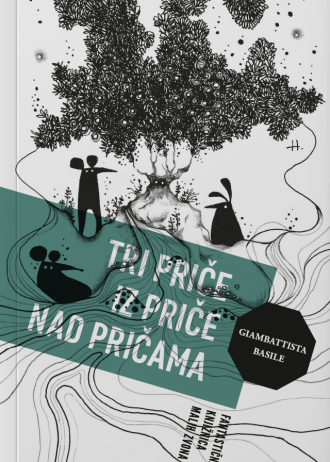
Mala zvona is proud to present the first Croatian translation of a selection of stories from Giambattista Basile’s famousTale of Tales (Lo cunto de li cunti or Il Pentamerone)
Basile’s collection, written in the 17th century in Neapolitan dialect, served as an inspiration to numerous fairy tale writers over the centuries; Basile’s motifs can be traced through many famous collections, such as those written by Perrault or the brothers Grimm.
In these grotesque stories – which are by no means intended for children – Basile teaches the reader about virtue, vice, deception and love while using a flamboyant Baroque rhetoric. Our selection includes the following stories: The Enchanted Doe, The Flea and The Old Woman Who Was Skinned who were also used as a pretext for Matteo Garrone’s multiple award-winning movie Il racconto dei racconti.