Format: 11×20
ISBN: 978-953-8313-52-3
Number of pages: 105
Paperback
Published: 2022.
Logbook
11,00 € 6,60 €
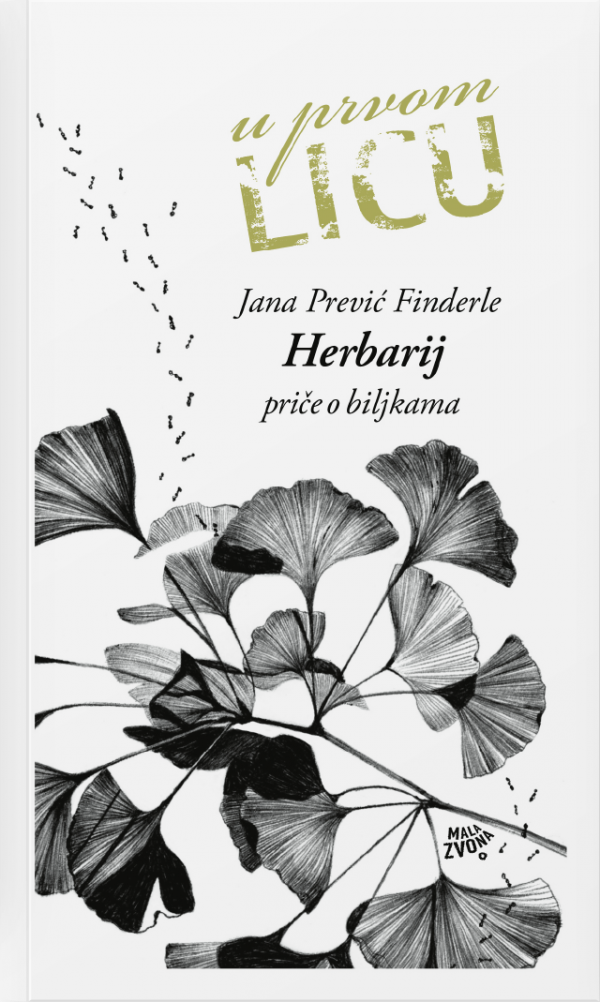
Jana Prević Finderle’s “Herbarium” could both be seen as a follow-up to her debut “The travertine bridge”, published in 2019, and its sheer opposite. One could argue that it’s a follow-up, because it is a book of short prose inspired by the author’s own experiences, delivered in a simple and direct way – and that it’s an opposite, as “The travertine bridge” was dedicated to travels and encounters, a horizontal motion through space, while “Herbarium”, a book about the lives of plants and the people closest to the author, focuses on travelling vertically, through time. For every herbarium, including Jana’s, is a book of memories. It seems that we live in times of increased sensitivity for the green world that surrounds us, a world that is getting more endangered with every day. But Jana’s soft spot for plantlife isn’t a result of any trend, although the need to create a herbarium made of words could have been influenced by the increasing eco-awareness in times of global warming. This author has, since early childhood, been living her life in close connection to plantlife, which enables her to talk about it from a personal, almost lyrical, perspective. Her authentic language depicts a simple closeness. The focus doesn’t lie on a problem or on the author’s knowledge of botany – which she clearly has – but rather on her personal experiences, her discoveries, little miracles she encounters, like the ones where her aunt Mirjana, in Jana’s adolescent days of spleen, tells her about an acorn and an oak.
Format: 11×20
ISBN: 978-953-8313-52-3
Number of pages: 105
Paperback
Published: 2022.
In this book that addresses every generation words and images blend into an impressive poetical unity. Using drawings with simple, clear lines and concise sentences, the author tells a story that’s possible to read and experience on different levels. She talks about the close connection of human beings with nature, about changes and the importance of that – sometimes concealed, but still permanent – relationship. The tree is also a symbol of the author’s inner being, a deep and vital center where her strength arises from, a strength of the utmost importance in encounters with the outside world and collisions with its walls.
In the legacy of Petar Gunjača (1924-2017), former employee in a furniture factory, known as photographer only to fans and collectors of photo equipment, were found several thousand photos, among them numerous shots of Zagreb from the 1960s and 1970s. Sometimes accidentally captured street scenes, sometimes persistent shooting of a same motive, sometimes deftly captured sport movement, suggestively evoke various urban atmospheres. Leading a kind of parallel life behind the lens, Petar Gunjača offers an impressive photographic opus and an interesting historical document. Inspired by Gunjača’s photos, the text writer Sanja Lovrenčić articulated her vision of the town in thirteen short prose fragments, intertwined with the story of the photographer’s life.
Book #3359
Mala zvona is proud to present the first Croatian translation of a selection of stories from Giambattista Basile’s famousTale of Tales (Lo cunto de li cunti or Il Pentamerone)
Basile’s collection, written in the 17th century in Neapolitan dialect, served as an inspiration to numerous fairy tale writers over the centuries; Basile’s motifs can be traced through many famous collections, such as those written by Perrault or the brothers Grimm.
In these grotesque stories – which are by no means intended for children – Basile teaches the reader about virtue, vice, deception and love while using a flamboyant Baroque rhetoric. Our selection includes the following stories: The Enchanted Doe, The Flea and The Old Woman Who Was Skinned who were also used as a pretext for Matteo Garrone’s multiple award-winning movie Il racconto dei racconti.