
Songs of Birth and Dying
10,00 €Collection of unconventional poems about love, written by a renowned Croatian poet.

11,00 €
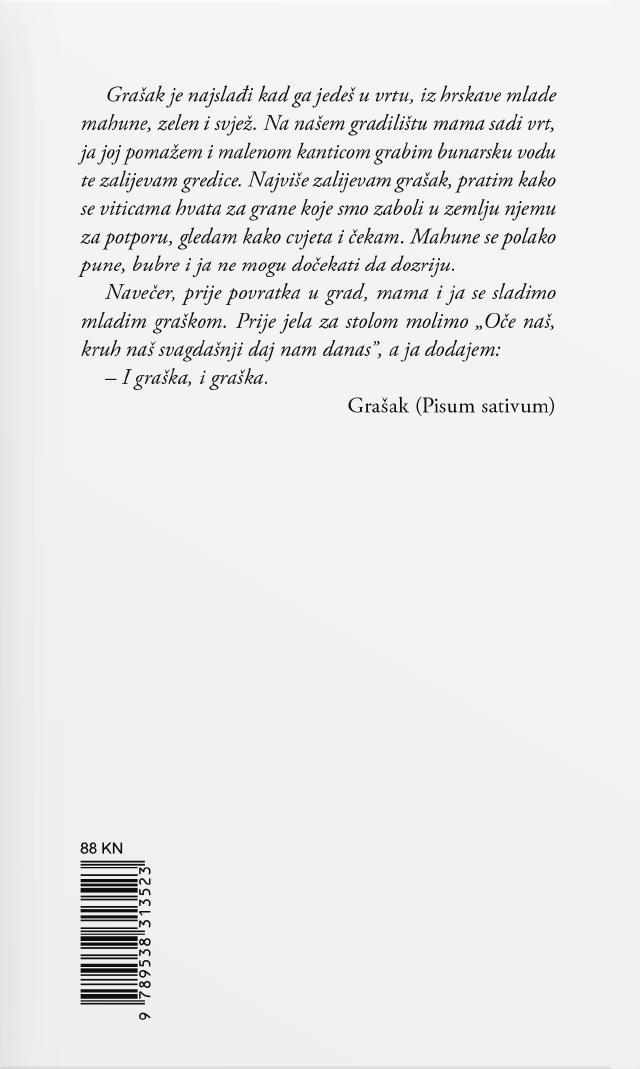
Jana Prević Finderle’s “Herbarium” could both be seen as a follow-up to her debut “The travertine bridge”, published in 2019, and its sheer opposite. One could argue that it’s a follow-up, because it is a book of short prose inspired by the author’s own experiences, delivered in a simple and direct way – and that it’s an opposite, as “The travertine bridge” was dedicated to travels and encounters, a horizontal motion through space, while “Herbarium”, a book about the lives of plants and the people closest to the author, focuses on travelling vertically, through time. For every herbarium, including Jana’s, is a book of memories. It seems that we live in times of increased sensitivity for the green world that surrounds us, a world that is getting more endangered with every day. But Jana’s soft spot for plantlife isn’t a result of any trend, although the need to create a herbarium made of words could have been influenced by the increasing eco-awareness in times of global warming. This author has, since early childhood, been living her life in close connection to plantlife, which enables her to talk about it from a personal, almost lyrical, perspective. Her authentic language depicts a simple closeness. The focus doesn’t lie on a problem or on the author’s knowledge of botany – which she clearly has – but rather on her personal experiences, her discoveries, little miracles she encounters, like the ones where her aunt Mirjana, in Jana’s adolescent days of spleen, tells her about an acorn and an oak.
Format: 11×20
ISBN: 978-953-8313-52-3
Number of pages: 105
Paperback
Published: 2022.
Collection of unconventional poems about love, written by a renowned Croatian poet.
Sanja Lovrenčić wrote the book of prose fragments entitled Zagreb Childhood in the Sixties while she was working on the translation of Walter Benjamin’s autobiographical Berlin Childhood around 1900,and her writing is therefore marked by an interesting duality. Zagreb Childhood functions as an autobiographical discourse and deals with the elements typical for that genre: introspection, sketches of the chosen period, a fine nostalgia for childhood, which an adult can reach only as a selection of fragments that can never be made into a coherent whole; those elements could be labelled as personal and local. On the other hand, however, the book is a response to a literary text, a reaction not to a childhood or a social change, but to a certain type of writing. This leads to a completely different set of ideas, that we might call inherently literary – intertextuality, the fictionalization of the self, the use of poetic language and lyrical fragments that simultaneously connote and transcend personal experience. Thus Zagreb Childhood combines two elements that are necessary to make a quality literature: inclusion in the local context, as well as its constant dissolution – both intimacy and universality.
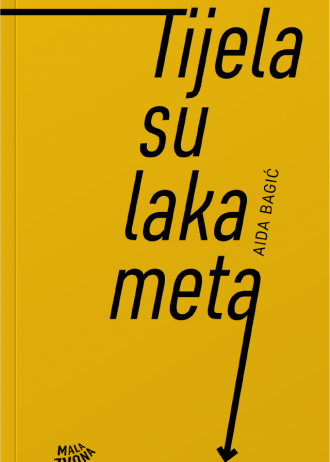
The new collection of poems by Aida Bagić was created during a period of several years, following her acclaimed book If my name is Sylvia (2007). Dealing with memories, everyday life, “sounds of her own interior”, the author is primarily concerned with poetic language, referring back to Croatian poets experimenters like Ivan Slamnig and Anka Žagar. Out of the memories, fragments of fairy tales, transformed shards of everyday life, Aida Bagić creates a coherent poetic world, affirming it again and again as the only fragile possibility of belonging.
In this book that addresses every generation words and images blend into an impressive poetical unity. Using drawings with simple, clear lines and concise sentences, the author tells a story that’s possible to read and experience on different levels. She talks about the close connection of human beings with nature, about changes and the importance of that – sometimes concealed, but still permanent – relationship. The tree is also a symbol of the author’s inner being, a deep and vital center where her strength arises from, a strength of the utmost importance in encounters with the outside world and collisions with its walls.